Cage: Etudes Australes
Sabine Liebner (piano)
one of Cage’s most deliberately complex works… [Liebner’s version is] expansive and dynamically varied
Cage: Etudes Australes
Sabine Liebner (piano)
Purchase product
one of Cage’s most deliberately complex works… [Liebner’s version is] expansive and dynamically varied
About
The composition of the ‘Etudes Australes’ in 1974 marks the beginning of a collection of virtuoso studies which represent Cage's renewed interest in traditional instrumentation and notation.
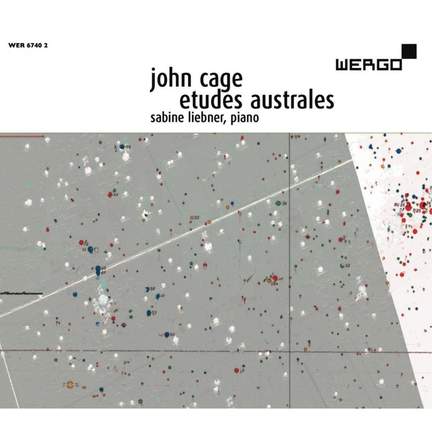
This complex piano composition consists of a total of 32 etudes divided into four books which John Cage based on maps of the southern night sky (‘Atlas Australis’). From these maps, locations of planets were selected via chance operations and translated into pitches. These heavenly bodies translated into pitches were notated on two systems, each of which encompasses the entire range of the piano keyboard for the right and left hands. Thus in this work, the aspect of chance also becomes an aesthetic category.
The ‘Etudes Australes’ have been recorded in a brilliant interpretation by the pianist Sabine Liebner: "The unexpected happens, because there is nothing to expect in these etudes. There is no logical sequence of events – everything is a representation of the stars. What happens here is what Cage always wanted: that the contradiction between art and life be dissolved. Art and life should not hinder each other, but form a unity, and this succeeds perfectly in the 'Etudes Australes', because what happens is always unanticipated." (Sabine Liebner) For Cage's composition, however, the moment of performance is its only moment of reality. Only what is in the present can be heard: in this case, a constantly changing kaleidoscope of sound with no expectation of repetition.
Contents and tracklist
- Sabine Liebner
- Sabine Liebner
- Sabine Liebner
- Sabine Liebner
Awards and reviews
 September/October 2012
one of Cage’s most deliberately complex works… [Liebner’s version is] expansive and dynamically varied
 19th January 2012
The technical and interpretative problems for the performer, who essentially has to treat each hand independently, are immense...as Sabine Liebner makes clear in her sleeve-note interview, [the recording has] been many years in preparation. That dedication comes through in her playing, in which every pitch and every chord, however arbitrary, is made to matter.