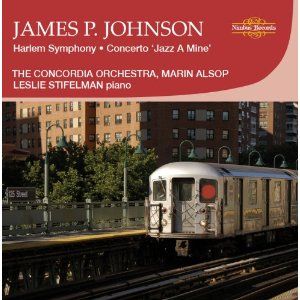
Special offer. James P. Johnson: Harlem Symphony & Jazz A Mine
Leslie Stifelman (piano), Chris Gekker (trumpet), Lawrence Feldman (clarinet), James Pugh (trombone), Frederick Boothe (tap-dancer)
The Concordia Orchestra, Marin Alsop
Drums has a tightness of organisation that is genuinely composerly. Driven forward by a timpani motif that torches a swirling, tearing-it-up percussion cadenza midway - a moment echoed later...
Special offer. James P. Johnson: Harlem Symphony & Jazz A Mine
Leslie Stifelman (piano), Chris Gekker (trumpet), Lawrence Feldman (clarinet), James Pugh (trombone), Frederick Boothe (tap-dancer)
The Concordia Orchestra, Marin Alsop
Purchase product
Drums has a tightness of organisation that is genuinely composerly. Driven forward by a timpani motif that torches a swirling, tearing-it-up percussion cadenza midway - a moment echoed later...
About
James P. Johnson was an astounding musician, arguably the most important black musician in New York during the decade of the 1920s. He is best known in jazz as the Father of Stride Piano, a two-handed, solo piano style that developed out of ragtime and flourished in the Northeast, especially Harlem, during the 1920s as the first true jazz piano idiom. He has influenced many successive jazz musicians, including his students Fats Waller and Duke Ellington. His stride piano composition, ‘Carolina Shout’ is considered by many to be the first recorded jazz piano solo (1921).
Johnson was the first black staff musician for the QRS piano roll company and favourite accompanist of Bessie Smith and Ethel Waters. As a composer, he scored all or part of at least 16 musical revues during the 1920s. Out of his 1923 Broadway production Runnin' Wild came the tune and dance most closely associated with the entire decade, the ‘Charleston’. Of all his accomplishments, James P. Johnson most wanted to be remembered as a serious composer of symphonic music utilizing African-American musical themes.
Despite little recognition and limited encouragement, James P. Johnson would write two symphonies, a piano and a clarinet concerto, two ballets, two one-act operas and a number of sonatas, suites, tone poems and a string quartet. The pioneering jazz writer Rudi Blesh visited Johnson at his home a few years before Johnson suffered a paralyzing stroke. The composer was happy to show Blesh his scores and play some of the themes for him. Blesh later wrote about his private audition:
‘These are long works with a feeling of breadth and sweep and with a racial pungency that Gershwin missed, and their African rhythms move with a forthright nobility. One feels none of these qualities as borrowed – they all reside in the dark, diminutive composer himself.’
Contents and tracklist
- Chris Gekker (trumpet), Lawrence Feldman (clarinet), James Pugh (trombone), Leslie Stifelman (piano)
- The Concordia Orchestra
- Marin Alsop
- Leslie Stifelman (piano)
- The Concordia Orchestra
- Marin Alsop
- Leslie Stifelman (piano)
- The Concordia Orchestra
- Marin Alsop
- Leslie Stifelman (piano)
- The Concordia Orchestra
- Marin Alsop
- Leslie Stifelman (piano)
- The Concordia Orchestra
- Marin Alsop
- Frederick Boothe (tap-dancer), Leslie Stifelman (piano)
- The Concordia Orchestra
- Marin Alsop
Awards and reviews
 December 2011
Drums has a tightness of organisation that is genuinely composerly. Driven forward by a timpani motif that torches a swirling, tearing-it-up percussion cadenza midway - a moment echoed later with a tumbling flute and timpani duo - Johnson's characteristic rhythmic stride ignites the whole work. It feels satisfyingly unified; idiom-perfect performances, too.