Muffat: Propitia Sydera
Concerti Grossi
Stefano Rossi (1st violin) & Irene De Ruvo (harpsichord & direction)
La Concordanza
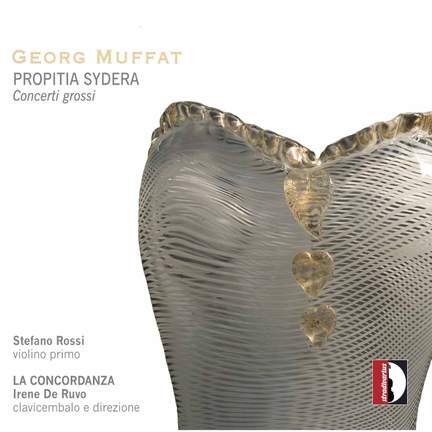
Muffat: Propitia Sydera
Concerti Grossi
Stefano Rossi (1st violin) & Irene De Ruvo (harpsichord & direction)
La Concordanza
Purchase product
About
In the preface to his Concerti Grossi, Muffat himself wrote about his musical studies in Paris, between 1663 and 1669 and of J. B. Lully among his mentors and masters of this art of music. Afterward Muffat was in Rome in order to perfect his organ-playing under Bernardo Pasquini, the brilliant and world-famous harpsichordist and organist of the time. He met and was greatly influenced by Arcangelo Corelli, and had the opportunity of listening to his music and in particular to his Concerti. Muffat’s Concerti Grossi were thus first inspired in Italy, in the Roman literary salons in which Corelli and Pasquini used to perform. In particular, they were inspired by the Church and Chamber sonate à tre composed and most probably performed in Rome by Corelli. The 1701 preface contains just as much information on the performance practice and concertation: these indications tell us how freely the number of parts were considered, always depending on the number of performers and therefore whether or not the parts could be doubled. Muffat also tells us of the composition of his concertino, a group of chosen performers that may include also wind instruments, typically French and bequest of Muffat’s French studies. However, the use of winds together with strings tells us more about the author’s aesthetical taste and more generally about baroque and tone variety: they contrast and juxtapose strings in a dialogue and an ever new and different collision. In the present recording the basso continuo is realized using harpsichord, harp, cello and violone following the indications for variety and full-bodied sound, both for the tutti and for the soli.
The CD includes also the Sonata for violin solo, which has an extremely free formal structure, incredibly original, in the Italian manner, alternating melodic movements (theme), rhythms (allegro fugato) and sections in a stylus phantasticus (adagio).
Contents and tracklist
- La Concordanza
- Irene de Ruvo
- La Concordanza
- Irene de Ruvo
- La Concordanza
- Irene de Ruvo
- Stefano Rossi, Irene de Ruvo
- La Concordanza
- Irene de Ruvo