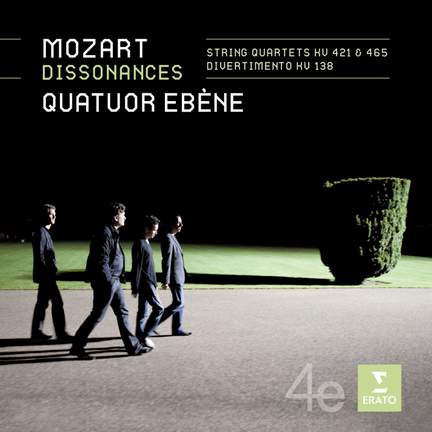
Special offer. Mozart: Dissonances
Quatuor Ebène
Awards:
-
Gramophone Magazine, November 2011, Editor's Choice

[the divertmenti are] normally done with full orchestral forces, but they work perfectly well as string quartets - especially when performed as immaculately as here, with everything honed to...
Special offer. Mozart: Dissonances
Quatuor Ebène
Purchase product
Awards:
-
Gramophone Magazine, November 2011, Editor's Choice
[the divertmenti are] normally done with full orchestral forces, but they work perfectly well as string quartets - especially when performed as immaculately as here, with everything honed to...
About
The Ebène Quartet’s fourth Virgin Classics release brings works that lie close to the origins of string-quartet writing – Mozart’s so-called ‘Haydn Quartets’. “It’s such amazing music, so rich and filled with such subtlety; completely unpretentious, yet of such genius,” says the Ebène’s first violin, Pierre Colombet.
After their multi-award-winning Virgin Classics debut with a CD of Debussy, Ravel and Fauré, a programme of Brahms, and the pop-jazz collection ‘Fictions’, the members of the Ebène Quartet turn to works that lie close to the very origins of string-quartet writing – Mozart’s so-called ‘Haydn Quartets’.
Composed in 1785, the set of six quartets was dedicated by Mozart to his friend and mentor Haydn, the acknowledged ‘father’ of the string quartet. The most famous of the set is the quartet in C major, KV 465, the ‘Dissonance’. It opens with a mysterious introduction, with layered harmonies creating the dissonance that gives the quartet its distinctive nickname. It is coupled with the quartet in D minor, KV 421 (another of the ‘Haydn Quartets) and the Divertimento in F major KV 138, written when Mozart was a teenager.
Pierre Colombet, first violin of the Quatuor Ebène explains the ensemble’s approach to Mozart: “We felt that, after Fictions, it would be a good idea to choose something really very classical, essential quartet music which went back to the roots of the quartet. We made a Haydn disc for another label some time ago, and we felt we just had to do some Mozart now. Yes, we’ve been playing Mozart for a very long time, but over the past year or two, we’ve felt more and more of a need to do it – it’s such amazing music, so rich and filled with such subtlety; completely unpretentious, yet of such genius.
And as Mathieu Herzog, the quartet’ viola vividly confesses: “It’s hardly news that classical musicians consider Mozart one of the most difficult composers to interpret, to play, to realise … you have to invest yourself constantly in his music and it’s very powerful, very tough on your emotions. And you have a weight on you – more like a layer of concrete on your head – because you want to succeed in delivering a new vision of the composer … We’re following in the footsteps of people who have played his music so very, very well and we want to respect Mozart for what he is. The whole thing is as hard as dancing Swan Lake in Caterpillar boots, but it’s worth the effort.
Pierre Colombet explains the title of their new release : “It might seem a bit of a paradox to call a Mozart disc ‘Dissonances’, even though he did write a quartet which is known as the ‘Dissonance’, but beyond that it’s true that Mozart’s music has loads and loads of very complex harmonies, sounds which create friction with each other.
Ebène’s cello Raphaël Merlin on the quartet’s interaction “When we’re playing Beethoven, Bartók or our jazz or pop repertoire, we use our instruments in a way that’s more percussive, that is more about the pressure we apply. But with Mozart it’s a matter of finding a natural resonance in our instruments, of letting them express themselves … almost of letting them communicate with each other in order to find the right resonance for this music. There is a phenomenon of sympathy – when the wood of an instrument’s soundbox vibrates and causes a vibration in the wood of an instrument close by. It’s that harmony that must link our instruments and that we ourselves must feel. It’s a very, very sensitive matter.”
Contents and tracklist
- Quatuor Ebène
- Recorded: 2011-02-05
- Recording Venue: 5-10 February 2011. Recording Ferme de Villefavard en Limousin.
Awards and reviews
-
Gramophone MagazineNovember 2011Editor's Choice
 December 2011
[the divertmenti are] normally done with full orchestral forces, but they work perfectly well as string quartets - especially when performed as immaculately as here, with everything honed to perfection. The Ebene Quartet produce playing of great refinement and warmth in the mature works, too, with the famous dissonant introduction to K465 admirably mysterious...the playing itself throughout this well-recorded disc remains something to marvel at.
 December 2011
the Ebène players point the way forward to the enhanced emotional intensity of the Romantic era. For readings that combine the best of the 'old' and the 'new' it is difficult to imagine these remarkable performances ever being surpassed. Exemplary engineering provides the icing on the cake.
 November 2011
The Quatuor Ébène trust Mozart's directive...These musicians bend and straighten, relax and tighten with micro-dynamic changes. All are intuitively sensed and go beyond literal obedience to the written markings. Yet pulse is steady and nothing is piecemeal or dislocated. Individual character comes first though...Interpretation is always carefully thought through and heartfelt
 30th October 2011
The Ebènes dig deep beneath the exquisite surface of this music to reveal its dark undercurrents. Taking their cue from the “Dissonance” nickname...they reveal similar drama and emotional conflict in the great D minor quartet and even the superficially innocent Divertimento, written when Mozart was a mere 15. Powerful, immaculately played performances.
 7th October 2011
At times brutally robust, at others so fragile you can hear the texture of the bow across the strings, this is a performance [of the D minor] that makes the hairs stand up on the back of your neck.
 24th September 2011
Is there a more characterful foursome than the Quatuor Ebène? Their wonderfully vivid playing here suggests not. Without being mannered or sensationalist, they disclose worlds of feeling. Just listen to the infinite variety of their phrasing in the finale of the stern D Minor Quartet, K421, as they leave the enigmatic ending hovering with a question mark.