Forqueray: The Complete Works for Harpsichord
Ketil Haugsand (harpsichord)
In the main, Haugsand is a detail-oriented interpreter, who employs more detached articulation along with a wide variety of agogic rhythmic stresses and accents...[he] wisely avoids those [repeats]...
Forqueray: The Complete Works for Harpsichord
Ketil Haugsand (harpsichord)
Purchase product
In the main, Haugsand is a detail-oriented interpreter, who employs more detached articulation along with a wide variety of agogic rhythmic stresses and accents...[he] wisely avoids those [repeats]...
About
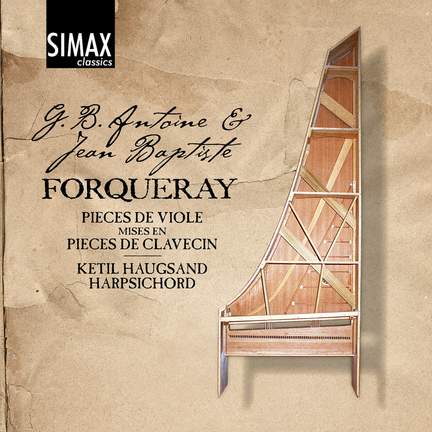
This 2-CD set performed on the harpsichord by the eminent keyboard player Ketil Haugsand features music written for the viola da gamba by Antoine Forqueray, a popular musician in the court of Louis XIV, arranged by his son, the composer Jean-Baptiste Forqueray.
Ketil Haugsand, professor of harpsichord at the Hochschule für Musik in Cologne, counts as one of the great harpsichordists and Early Music personalities of today. The Norwegian born musician studied among others with Gustav Leonhardt at the Amsterdam Conservatory, where he was awarded the coveted 'Prix d'Excellence'. He has recorded extensively in repertoire including Bach, Rameau, Marchand, Seixas and Sousa Carvalho.
Haugsand has built the harpsichord used on this recording himself and has based it on a Late-Flemish type instrument. In the late 1600s, the music family Forqueray was well established at the court of The Sun King Louis XIV. The new Italian style was the latest fashion, and father Antoine was a viola da gamba virtuoso. When Antoine died his son Jean-Baptiste published his father’s music for gamba, adding his own transcriptions and adaptations for the harpsichord.
Contents and tracklist
- Ketil Haugsand
- Ketil Haugsand
- Ketil Haugsand
- Ketil Haugsand
- Ketil Haugsand
- Ketil Haugsand
- Ketil Haugsand
- Ketil Haugsand
- Ketil Haugsand
- Ketil Haugsand
- Ketil Haugsand
- Ketil Haugsand
- Ketil Haugsand
- Ketil Haugsand
Awards and reviews
 November 2011
In the main, Haugsand is a detail-oriented interpreter, who employs more detached articulation along with a wide variety of agogic rhythmic stresses and accents...[he] wisely avoids those [repeats] that prolong certain movements beyond their natural momentum.