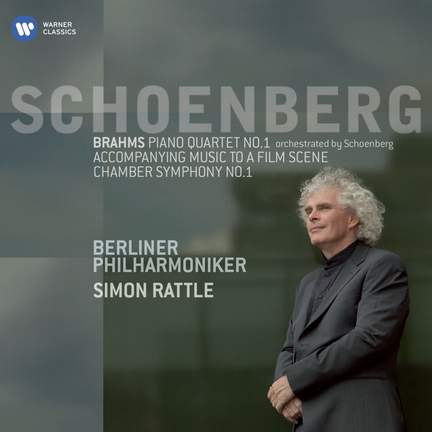
Schoenberg: Orchestral Works
Recorded in concert 30th October - 7th November 2009
Berliner Philharmoniker, Sir Simon Rattle
Awards:
-
Presto Recording of the Week, 8th August 2011

Accompaniment to a Film Scene...sounds less nightmarish, and a lot more beautiful than in any previous version. In general, Rattle's Schoenberg is more the voluptuous late Romantic than the...
Schoenberg: Orchestral Works
Recorded in concert 30th October - 7th November 2009
Berliner Philharmoniker, Sir Simon Rattle
Purchase product
Awards:
-
Presto Recording of the Week, 8th August 2011
Accompaniment to a Film Scene...sounds less nightmarish, and a lot more beautiful than in any previous version. In general, Rattle's Schoenberg is more the voluptuous late Romantic than the...
About
Following the release of the complete Brahms symphonies ("Altogether a marvellous achievement." The Daily Telegraph), Sir Simon Rattle and the Berliner Philharmoniker have performed and recorded a programme of orchestral works by Arnold Schoenberg, who was a great admirer of Brahms.
In these three contrasting works, the spirits of Modernism, Romanticism and Classicism are invoked by Arnold Schoenberg – a revolutionary whose aesthetic roots lay firmly in tradition. Sir Simon Rattle, who first established his international reputation with masterpieces of the 20th century, explores these musical cross-currents with the Berliner Philharmoniker, long supreme in Austro-German repertoire.
The repertoire, recorded in concert at Berlin’s Philharmonie in late October/early November 2009, consists of Schoenberg’s orchestration of Brahms’s Piano Quartet in G minor, Begleitungsmusik zu einer Lichtspielszene (Accompanying Music to a Film) and the full orchestra version of the Chamber Symphony No. 1.
In these three contrasting works, the spirits of Modernism, Romanticism and Classicism are invoked by Arnold Schoenberg – a revolutionary whose aesthetic roots lay firmly in tradition. Sir Simon Rattle, who first established his international reputation with masterpieces of the 20th century, explores these musical cross-currents with the Berliner Philharmoniker, long supreme in Austro-German repertoire.
Immediately after the recent performances/recordings, Sir Simon and the Orchestra set off on a coast-to-coast U.S. tour performing the Brahms symphonies and this Schoenberg programme at New York’s Carnegie Hall and in San Francisco, Los Angeles, Boston, Chicago and Ann Arbor.
Schoenberg said that he had arranged Brahms’s Piano Quartet in G minor, Op. 25 for orchestra in 1937 for several reasons: “1) I like this piece; 2) It is seldom played; 3) It is always played badly, because the better the pianist, the louder he plays and you hear nothing from the strings. I wanted once to hear everything, and this I achieved.” He also stated that he intended to write his orchestration strictly in the style of Brahms, going no further than Brahms would have gone “if he had lived today.”
Mark Swed, in The Los Angeles Times, said of the LA performance, “When [Schoenberg] made the version in 1937, he had recently moved from Berlin to Los Angeles and was clearly entranced by the resplendent light of his new home. He garbs the quartet in garish instrumental colors … Rattle emphasized everything in the most polystylistic way possible. A horn solo in the solo movement had a raw jazzy quality; a clarinet solo in the Gypsy-inspired last movement was klezmer-like. A xylophone clattered, a bass drum thumped. But within this ruckus was also ravishing ensemble playing and, from Rattle, the inspiration not only for great characterization but also for momentum.”
Allan Kozinn in The NY Times wrote of the Carnegie Hall performance, “It can be hard to banish the original sound and texture from your inner ear, however convincing the new interpretation may sound. But it can be worth the effort, as Mr. Rattle and his musicians demonstrated in a vital, shapely account that found levels of drama in Schoenberg’s magnification that a performance of the chamber version could not possibly equal.” Simon Rattle previously recorded this work with the City of Birmingham Symphony Orchestra in 1985.
Contents and tracklist
- Berliner Philharmoniker
- Sir Simon Rattle
- Recorded: 2009-10-30
- Recording Venue: 30 & 31 October, 5-7 November 2009 recorded in Concert, Philharmonie, Berlin.
- Berliner Philharmoniker
- Sir Simon Rattle
- Recorded: 2009-10-30
- Recording Venue: 30 & 31 October, 5-7 November 2009 recorded in Concert, Philharmonie, Berlin.
- Berliner Philharmoniker
- Sir Simon Rattle
- Recorded: 2009-10-30
- Recording Venue: 30 & 31 October, 5-7 November 2009 recorded in Concert, Philharmonie, Berlin.
Spotlight on this release
-
An error occurred.
Try watching this video on www.youtube.com, or enable JavaScript if it is disabled in your browser.
An extract from the Schoenberg Chamber Symphony No. 1 -
Brahms/Schoenberg from Rattle and the Berliner Philharmoniker
8th Aug 2011
Rattle conducts Schoenberg’s orchestration of the Brahms Piano Quartet in G minor, plus the Chamber Symphony No. 1 and Accompanying Music to a Cinematographic Scene.

Awards and reviews
-
Presto Recording of the Week8th August 2011
 October 2011
Accompaniment to a Film Scene...sounds less nightmarish, and a lot more beautiful than in any previous version. In general, Rattle's Schoenberg is more the voluptuous late Romantic than the bogeyman of popular legend.
 October 2011
you can tell at once that this is the Berlin Phil, so smooth and seductive are their dulcet tones. This is high sonic luxury, with Rattle coaxing on the hushed plush strings, the silken clarinets, the gold-leaf sound of the trumpets.
 October 2011
The BPO woodwind and strings, with horn priming the canvas, are absolute ringers [for Brahms], but a deeper truth emerges from Rattle's delight in (or celebration of) moments where Schoenberg's orchestration goes a bit Mike Yarwood...The omnivorous virtuoso shout of the final moments [of the Chamber Symphony] spills beyond the usual orchestral threshold, the BPO demonstrating why they're the BPO.
 July 2012
The Berliners’ playing is absolute perfection.
 August 2014
Despite its name, the Accompaniment to a Cinematographic Scene was not written for a specific film, but rather as imagined music for a hypothetical one, with three movements entitled Imminent Danger, Anxiety, and Catastrophe. Simon Rattle conducts the Berlin Philharmonic in a fine performance, coupled with the orchestral version of Chamber Symphony No. 1, and Schoenberg's orchestration of Brahms's Piano Quartet No. 1 in G minor.
 28th August 2011
[The Chamber Symphony] is a contradiction in terms with the Berliners’ massed and sleek strings, but the performance moves Schoenberg closer to Brahms, to which the former would certainly not have objected. For those out there who remain afraid of Schoenberg, this disc is an ideal entry point.
 25th August 2011
[Accompaniment to a Film Scene is] superbly played by the Berlin Phil, with Rattle encapsulating perfectly its concentrated drama.
 5th August 2011
[The Brahms] is full of dash and gusto, especially during the concluding Rondo alla Zingarese. Elsewhere, the "Accompaniment to a Cinematographic Scene" offers a peek at the complex musical dramaturgy furnished by dissonant developments of the composer's later career.
 25th August 2011
The sound is amazingly clear, and the virtuosity of the players, especially in the mad Hungarian dance of the finale [of the Piano Quartet], is astounding...[the Chamber Symphony is] performed with both heart-stopping urgency and radiant beauty.
 19th August 2011
Schoenberg’s version offers ingenious fun, and Rattle’s Berlin players, recorded two years ago in live concerts, dispatch it with loving swagger.
The Independent on Sunday 12th September 2011
The accompanying pieces demonstrate the Berliners' litheness, while Schoenberg's bizarre orchestration of Brahms moves from academic exercise to cartoonish fantasy in four movements.