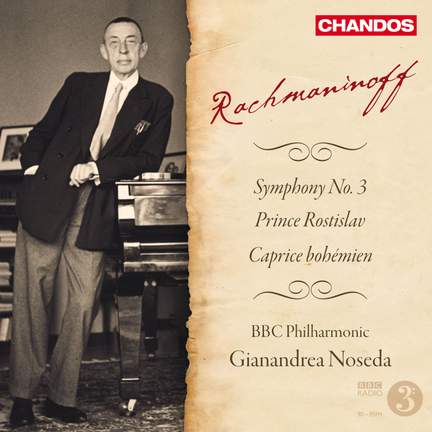
Rachmaninoff: Symphony No. 3
BBC Philharmonic, Gianandrea Noseda
Awards:
-
Building a Library, March 2016, Also Recommended

Noseda's unexpected and very welcome use of rubato reveals the drama of the opening exposition, making the music sound purposeful rather than a Hollywood-style wallow.
Rachmaninoff: Symphony No. 3
BBC Philharmonic, Gianandrea Noseda
Purchase product
Awards:
-
Building a Library, March 2016, Also Recommended
Noseda's unexpected and very welcome use of rubato reveals the drama of the opening exposition, making the music sound purposeful rather than a Hollywood-style wallow.
About
This is the sixth volume in our highly acclaimed Rachmaninoff series, performed by the BBC Philharmonic under Gianandrea Noseda. Of Symphony No. 1 on a previous volume in this series (CHAN10475), BBC Music magazine said: ‘Noseda and the BBC Philharmonic have the work’s measure and their performance has a full-blooded intensity and fire.’ The series has been well received by the public and reviewers alike, and many of the recorded works will be performed by Noseda and the BBC Philharmonic at this year’s Proms.
Symphony No. 3 is the most expressively Russian of all Rachmaninoff’s symphonies, particularly in the dance rhythms of the energetic finale. Rachmaninoff wrote the symphony for the Philadelphia Orchestra, having spoken fondly of the ensemble, calling it ‘my very favourite orchestra’. The premiere was conducted by the charismatic Leopold Stokowski, but reviews were mixed – leaning towards the negative – and it was not until the re-evaluation of Rachmaninoff’s works in the 1970s that this symphony finally got the recognition that it deserves.
Rarely recorded and performed today, the symphonic poem Prince Rostislav is one of Rachmaninoff’s earliest surviving compositions for orchestra. Based on a short ballad by Alexey Tolstoy, the highly atmospheric and evocative music speaks of the ill-fated Prince of Kiev who was tragically drowned in the Ukrainian river Dniepr.
Equally unfamiliar is Capriccio bohémien, the colourful fantasy by Rachmaninoff on a gypsy theme, which takes much of its inspiration from one of the composer’s other works, the opera Aleko, based on Pushkin’s The Gypsies.
Contents and tracklist
Awards and reviews
 September 2011
Noseda's unexpected and very welcome use of rubato reveals the drama of the opening exposition, making the music sound purposeful rather than a Hollywood-style wallow.
 September 2011
Their instinctive phrasing, ability to build and release tension, and strong dynamic contrasts manage to capture Rachmaninov's evocative scores without over-egging them, all with a satisfying orchestral balance...this disc is worth buying for its dramatic, nuanced interpretation of the rarely-record[ed] Prince Rostislav alone.
 October 2011
a particularly fine performance of the Third Symphony. Those waves of nostalgia coupled with piquant instrumentation and incisive rhythmicality typical of Rachmaninov's idiom in the last decades of his life are ideally caught by Noseda and an orchestra that has been well drilled in finding the appropriate timbes and textures.
 28th July 2011
Both [shorter] works receive finely detailed, crisp performances from the BBC Philharmonic, but nevertheless it's Noseda's superb account of Rachmaninov's Third Symphony that takes pride of place here – wonderfully restrained, almost haunted in its opening movement; quietly nostalgic in its central Adagio; and almost neurotically hyperactive in its finale.
 21st July 2011
The chief reason for investing in this disc would be the fine, lucid, characterful performance of Rachmaninoff’s Third Symphony. But Noseda devotes as much care and attention to Prince Rostislav and the Caprice bohémien...they harbour music of atmosphere and creative imagination that Noseda and the orchestra tap purposefully.