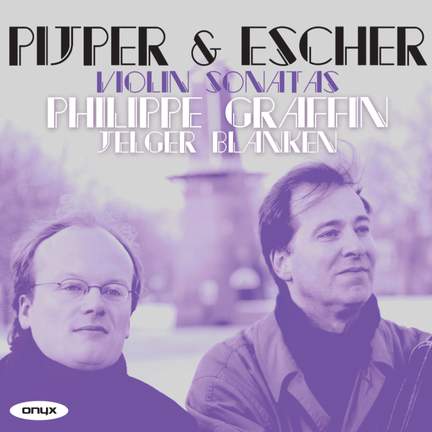
Pijper & Escher: Violin Sonatas
Philippe Graffin (violin) & Jelger Blanken (piano)
First-rate, spry and sensitive playing makes Graffin's and Blanken's advocacy persuasive.
Pijper & Escher: Violin Sonatas
Philippe Graffin (violin) & Jelger Blanken (piano)
Purchase product
First-rate, spry and sensitive playing makes Graffin's and Blanken's advocacy persuasive.
About
Unfamiliar names to many, Willem Pijper and Rudolf Escher are the two major figures in 20th-century Dutch music.
Pijper was a symphonist, composer of operas, and a noted writer on music, and his enthusiasm for motor cars saw him publishing ‘The Artistic Side of Motoring’.
One of Pijper’s pupils was Escher, who assimilated the influences of Debussy, Schoenberg and Ravel. He composed two symphonies and became a noted expert on modern music, embracing Boulez.
Hardly better known outside of Holland is Ton de Leeuw, who worked under Messiaen and Hartmann. His early music shows influences of Bartók, Hindemith and Pijper. The Violin Sonata dates from 1951. His later works reflect his interest in music from India and the Far East, and electronic sounds.
This is an important release of little-known music by the most influential Dutch composers of the last century.
Contents and tracklist
- Philippe Graffin, Jelger Blanken
- Philippe Graffin, Jelger Blanken
- Philippe Graffin, Jelger Blanken
- Philippe Graffin, Jelger Blanken
- Philippe Graffin, Jelger Blanken
- Philippe Graffin, Jelger Blanken
- Philippe Graffin, Jelger Blanken
Awards and reviews
 October 2011
First-rate, spry and sensitive playing makes Graffin's and Blanken's advocacy persuasive.
 12th June 2011
the pieces by Pijper, Rudolf Escher, Alexander Voormolen and Ton de Leeuw set one thinking. Memorable are such moments as when the concluding scherzando of Pijper’s Sonata No 1 transforms into a haunting adagio. And De Leeuw’s tiny, spectral improvisation on a Dutch Christmas carol is itself a pure enigma.
 21st July 2011
Dutch 20th-century violin sonatas might be a niche area, but when an artist of Philippe Graffin’s calibre espouses them you tend to sit up and take notice. Willem Pijper offers a unique slant on French Impressionism in two sonatas with piano while Rudolf Escher looks back to Ravel and voices personal anguish triggered by the Second World War.