Special offer. Palestrina Volume 1
The Sixteen, Harry Christophers
The whole effect is quasi-theatrical without being melodramatic. The Mass also has its virtues from the vigour of the Kyrie...to the delicate duetting of the Osanna. The recording retains the...
Special offer. Palestrina Volume 1
The Sixteen, Harry Christophers
Purchase product
The whole effect is quasi-theatrical without being melodramatic. The Mass also has its virtues from the vigour of the Kyrie...to the delicate duetting of the Osanna. The recording retains the...
About
2011 sees the first recording by The Sixteen devoted entirely to Palestrina.
The disc marks the start of a new project which will result in a series of new recordings exploring a selection of the composer’s vast output, and a Choral Pilgrimage tour.
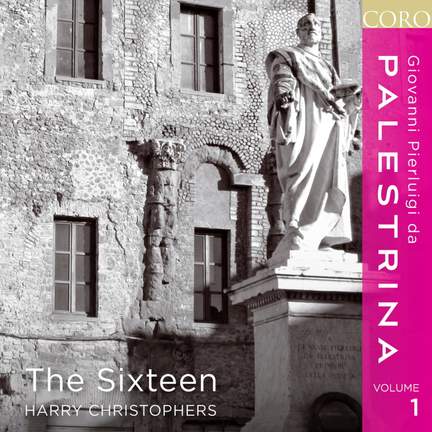
Palestrina was born in 1525 not far from Rome, in the town whose name he bore and from which we take the cover images for this new series of discs. Possibly the greatest composer of liturgical music of all time, Palestrina was a towering figure in Renaissance polyphony. Choral singers world-wide will know his Missa Papae Marcelli (recorded by The Sixteen on COR16014) as, without doubt, it is the most renowned of Palestrina’s works and possibly the most famous mass of all time.
On this new disc The Sixteen has recorded some of the sumptuous music he wrote for the Assumption including his Missa Assumpta est Maria and Salve Regina. Without doubt, Palestrina was the great master of all Papal composers and his spiritual craft and harmonic vitality fulfilled the needs of the Vatican. His motets for the Assumption also entitled Assumpta est Maria, are glorious examples of such work and can be heard in all their splendour on this recording.
By his death in 1594, Palestrina had published a huge amount of music including over 100 Masses and over 350 motets.
Contents and tracklist
Spotlight on this release
-
An error occurred.
Try watching this video on www.youtube.com, or enable JavaScript if it is disabled in your browser.
Awards and reviews
 September 2011
The whole effect is quasi-theatrical without being melodramatic. The Mass also has its virtues from the vigour of the Kyrie...to the delicate duetting of the Osanna. The recording retains the spaciousness of the largish choir...the imaginative variety of these performances bodes well for future volumes in this series.
 September 2011
The abstract beauty of the singers' approach to the Missa Assumpta Est Maria and the breathless beauty of Song of Songs shows The Sixteen's adaptability and resourcefulness. Another tick in their box - the naturalistic sound quality which avoids the contrived 'other-worldly' quality that plagues lesser early music recordings.
 October 2011
This is Palestrina sung in the English manner but so well done that I suspect unprejudiced reviewers everywhere will give it a sympathetic hearing. The Sixteen are indeed on fine form...Christophers has a gift for taking his audience by the hand, and in that spirit it would be good to show off as many sides of Palestrina as possible.
 September 2011
it is the Missa 'Assumptis est Maria' that most clearly exhibits both Palestrina's and The Sixteen's art, with superbly deployed polyphonic, homophonic and antiphonal textures made to surge and recede like vast waves of sound...an auspicious start to what one hopes will be a long-running series
 5th June 2011
The parodic Missa Assumpta est Maria makes an excellent beginning, this performance showing Christophers’s avowed intent of making the most of the expressive lines. The other works in a beautifully shaped and sung recital include the mesmeric offertory piece Diffusa est gratia.
 2nd June 2011
One of the aims of the series, Christophers says, is to achieve a "real ebb and flow" in music, which can "sound all too perfect and occasionally academic". There's certainly no hint of that here; the performances are wonderfully alive to both the verbal and the musical meaning, the sound of the 18 voices of the Sixteen consistently warm and transparent.
 21st July 2011
The Sixteen and Harry Christophers launch the first volume of a long-term Palestrina project, using their instincts to convey not just the mellifluous perfection of Palestrina’s polyphonic vocal writing but also the music’s expressive import.