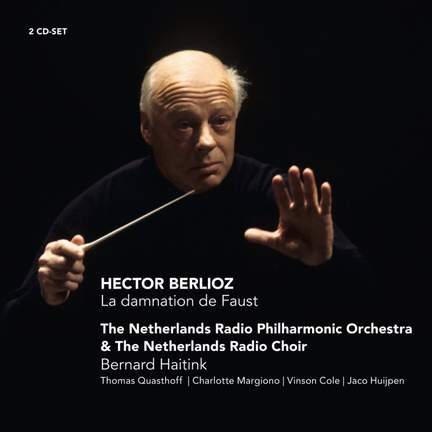
Berlioz: La Damnation de Faust, Op. 24
Charlotte Margiono (soprano), Vinson Cole (tenor), Thomas Quasthoff (baritone) & Jaco Huijpen (bass)
The Netherlands Radio Philharmonic Orchestra & The Netherlands Radio Choir, Bernard Haitink
Haitink's increasingly dramatic reading of the score comfortably outstrips [Furtwängler and Solti]. Concern that his rather classical Marche hongroise is eschewing the danger and violence implicit...
Berlioz: La Damnation de Faust, Op. 24
Charlotte Margiono (soprano), Vinson Cole (tenor), Thomas Quasthoff (baritone) & Jaco Huijpen (bass)
The Netherlands Radio Philharmonic Orchestra & The Netherlands Radio Choir, Bernard Haitink
Purchase product
Haitink's increasingly dramatic reading of the score comfortably outstrips [Furtwängler and Solti]. Concern that his rather classical Marche hongroise is eschewing the danger and violence implicit...
About
This memorable performance of Berlioz's masterpiece The Damnation of Faust was recorded in 1999, and is being released for the first time on CD to support the campaign against the Dutch government’s plans to abolish the Muziekcentrum van de Omroep (MCO) and its orchestras - which include the Netherlands Radio Philharmonic. The conductor is the legendary Bernard Haitink, who began his career with the orchestra, and the soloists include Vinson Cole and Thomas Quastoff.
The Netherlands Radio Philharmonic Orchestra gave its first concert on 7 October 1945. Initially it spent most of its time in studios working on a large number of recordings for the public broadcasting system. Illustrious soloists such as Kathleen Ferrier, Elisabeth Schwarzkopf, Clara Haskil and Jean-Pierre Rampal have shared the stage with the orchestra. In 1956 Bernard Haitink became a guest conductor with the Concertgebouw Orchestra, and he was appointed the principal conductor of the Netherlands Radio Philharmonic Orchestra in the following year. Since then, during an illustrious career, he has been chief conductor with, amongst others, the Concertgebouw orchestra, the London Philharmonic and more recently the Chicago Symphony orchestra. He has also had a long standing relationship with the Royal Opera House, Covent Garden.
Hector Berlioz’s “dramatic legend” was first performed at the Opéra-Comique in Paris on 6th December 1846. It is based on a poem by Goethe, and features four solo voices, full seven-part chorus, large children's chorus and orchestra.
Contents and tracklist
- Jaco Huijpen (soloist), Vinson Cole (soloist), Thomas Quasthoff (soloist), Charlotte Margiono (soloist)
- The Netherlands Radio Choir, The Netherlands Radio Philharmonic Orchestra
- Bernard Haitink
- Jaco Huijpen (soloist), Vinson Cole (soloist), Thomas Quasthoff (soloist), Charlotte Margiono (soloist)
- The Netherlands Radio Choir, The Netherlands Radio Philharmonic Orchestra
- Bernard Haitink
- Vinson Cole (soloist), Jaco Huijpen (soloist), Charlotte Margiono (soloist), Thomas Quasthoff (soloist)
- The Netherlands Radio Choir, The Netherlands Radio Philharmonic Orchestra
- Bernard Haitink
- Charlotte Margiono (soloist), Jaco Huijpen (soloist), Vinson Cole (soloist), Thomas Quasthoff (soloist)
- The Netherlands Radio Choir, The Netherlands Radio Philharmonic Orchestra
- Bernard Haitink
Awards and reviews
 June 2011
Haitink's increasingly dramatic reading of the score comfortably outstrips [Furtwängler and Solti]. Concern that his rather classical Marche hongroise is eschewing the danger and violence implicit in Berlioz's wind and brass scoring is soon allayed by his pulse and pace in the big choral ensembles...the chamber-like delicacy of the sylph music and his evident emotional commitment to the perils of Faust's predicament.
 July 2011
Haitink's grasp of the score is remarkable and the playing of the March has a really thrilling abandon...Cole's Faust is is sweet-toned and lyrical, matched by Thomas Quasthoff's agile and well-characterized Mephistopheles...Marguerite is sung by the soprano Charlotte Margiono with considerable tenderness...The choral contribution is superbly responsive throughout.
 19th May 2011
it quickly becomes obvious that Haitink's account of a work he's never recorded commercially is well worth releasing in its own right. He obtains playing of refinement and precision from the Netherlands Radio Philharmonic, and the orchestral set pieces like the Hungarian March and the Minuet of the Will o' the Wisps are perfectly judged. Vinson Cole is the wonderfully articulate Faust and Charlotte Margiono a touching Marguerite