Rossini: Guillaume Tell
Gerald Finley (Guillaume Tell), John Osborn (Arnaud), Malin Byström (Mathilde), Marie-Nicole Lemieux (Hedwige), Matthew Rose (Walter Furst), Frédéric Caton (Melchtal), Elena Xanthoudakis (Jemmy), Carlo Cigni (Gesler), Carlo Bosi (Rodolphe), Celso Albelo (Ruodi), Dawid Kimberg (Leuthold), Davide Malvestio...
Awards:
-
Presto Recording of the Week, 11th July 2011

-
BBC Music Magazine, September 2011, Opera Choice

In the tenor spotlight is John Osborn, whose liquid voice often takes to the air with ease...Finley is at the top of his game...Where the set gains the bulk of its authority is in Pappano's...
Rossini: Guillaume Tell
Gerald Finley (Guillaume Tell), John Osborn (Arnaud), Malin Byström (Mathilde), Marie-Nicole Lemieux (Hedwige), Matthew Rose (Walter Furst), Frédéric Caton (Melchtal), Elena Xanthoudakis (Jemmy), Carlo Cigni (Gesler), Carlo Bosi (Rodolphe), Celso Albelo (Ruodi), Dawid Kimberg (Leuthold), Davide Malvestio...
Purchase product
Awards:
-
Presto Recording of the Week, 11th July 2011
-
BBC Music Magazine, September 2011, Opera Choice
In the tenor spotlight is John Osborn, whose liquid voice often takes to the air with ease...Finley is at the top of his game...Where the set gains the bulk of its authority is in Pappano's...
About
Rossini’s complete final French Grand Opera William Tell in its definitive critical edition brough vividly to life by Antonio Pappano, Orchestra e coro dell’Accademia Nazionale di Santa Cecilia under his musical directorship and a stellar international cast.
Recorded live in concerts in October and December 2010 at the Accademia’s home Auditorium Parco della Musica led by Canadian baritone Gerald Finley in the title role and American tenor John Osborn, discovered by Antonio Pappano for this recording, in the notoriously challenging high role of Arnold of which he is a rare exponent.
Rossini’s opera established the structure of Grand Opera in separate scenes which was used by Bellini, Donizetti and Verdi. The music Rossini wrote for Arnold took operatic tenor singing style out of “chest” and “falsetto” (for the high notes), as was the norm until then, creating the powerful extended full vocal range we know today and which continues to make Italianate operatic tenor singing so thrilling.
The work had a huge influence on music history and is a fitting one for Pappano to champion in his active role as presenter of the history of opera by Italian composers from the beginning to the 20th century.
“The orchestra is fleet and wonderfully together, with crunch, buoyancy, a keen sense of collective phrasing and its own very distinctive sound…An excellent cast, led by Gerald Finley, on magnificent form…[Pappano’s] singers brought meaning to every phrase, giving us driven motivated vocal lines”. The Financial Times
Artists
Gerald Finley (Guillaume Tell), John Osborn (Arnaud), Malin Byström (Mathilde), Marie-Nicole Lemieux (Hedwige), Matthew Rose (Walter Furst), Frédéric Caton (Melchtal), Elena Xanthoudakis (Jemmy), Carlo Cigni (Gesler), Carlo Bosi (Rodolphe), Celso Albelo (Ruodi), Dawid Kimberg (Leuthold), Davide Malvestio (Un Chasseur)
Orchestra e coro dell’Accademia Nazionale di Santa Cecilia, Antonio Pappano
Contents and tracklist
- Gabriele Gemignani (cello)
- Orchestra dell'Accademia Nazionale di Santa Cecilia
- Antonio Pappano
- Recorded: 2010-10-01
- Recording Venue: 16, 18 & 20 October and 18, 20 &21 December, 2010, Sala Santa Cecilia, Auditorium Parco della Musica, Rome
- Orchestra dell'Accademia Nazionale di Santa Cecilia, Celso Albelo (tenor), Elena Xanthoudakis (soprano), Gerald Finley (baritone), Marie-Nicole Lemieux (contralto), Ciro Visco (director), Frédéric Caton (baritone), John Osborn (tenor)
- Coro dell'Accademia Nazionale Di Santa Cecilia
- Antonio Pappano
- Ciro Visco (director), Frédéric Caton (baritone), Marie-Nicole Lemieux (contralto), Celso Albelo (tenor), Elena Xanthoudakis (soprano), Gerald Finley (baritone), John Osborn (tenor)
- Coro dell'Accademia Nazionale Di Santa Cecilia, Orchestra dell'Accademia Nazionale di Santa Cecilia
- Antonio Pappano
- Frédéric Caton (baritone), Gerald Finley (baritone)
- Orchestra dell'Accademia Nazionale di Santa Cecilia
- Antonio Pappano
- Marie-Nicole Lemieux (contralto), John Osborn (tenor), Ciro Visco (director), Elena Xanthoudakis (soprano), Frédéric Caton (baritone), Gerald Finley (baritone)
- Orchestra dell'Accademia Nazionale di Santa Cecilia, Coro dell'Accademia Nazionale Di Santa Cecilia
- Antonio Pappano
- Celso Albelo (tenor), Ciro Visco (director), Dawid Kimberg (baritone), Elena Xanthoudakis (soprano), Frédéric Caton (baritone), Gerald Finley (baritone), Marie-Nicole Lemieux (contralto)
- Coro dell'Accademia Nazionale Di Santa Cecilia, Orchestra dell'Accademia Nazionale di Santa Cecilia
- Antonio Pappano
- Carlo Bosi (tenor), Ciro Visco (director), Elena Xanthoudakis (soprano), Frédéric Caton (baritone), Marie-Nicole Lemieux (contralto), Orchestra dell'Accademia Nazionale di Santa Cecilia
- Coro dell'Accademia Nazionale Di Santa Cecilia
- Antonio Pappano
- Ciro Visco (director), Davide Malvestio (baritone)
- Coro dell'Accademia Nazionale Di Santa Cecilia, Orchestra dell'Accademia Nazionale di Santa Cecilia
- Antonio Pappano
Spotlight on this release
-
An error occurred.
Try watching this video on www.youtube.com, or enable JavaScript if it is disabled in your browser.
-
Rossini’s William Tell
11th Jul 2011
Gerald Finley is the sharp-shooting Swiss hero on Antonio Pappano’s absorbing account of Rossini’s opera, with John Osborn sounding effortless in the taxing high role of Arnaud, and Malin Byström an expressive Mathilde.

Awards and reviews
-
Presto Recording of the Week11th July 2011
-
BBC Music MagazineSeptember 2011Opera Choice
 September 2011
In the tenor spotlight is John Osborn, whose liquid voice often takes to the air with ease...Finley is at the top of his game...Where the set gains the bulk of its authority is in Pappano's conducting: passionate, alert to detail and ideally placed.
 27th July 2011
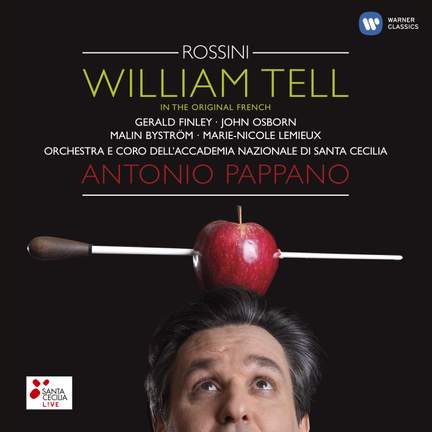
[Osborn's] combination of supreme vocal agility, phenomenal stamina and tonal beauty is a principal asset of this new set...the sound is vivid and atmospheric...EMI has gone to town on the packaging, from the fat booklet full of photos, intelligent notes and complete libretto (unusual these days) to the witty cover image.
 September 2011
in the hands of Pappano and a superb cast, the drama is brought to life with vivid details of light and shade...Pappano creates sudden dramatic pianissimi in 'Gloire au pouvoir supreme', a chorus in praise of the Austrian tyrant Gesler. It's a masterstroke. It's as if the villagers are actually cowering in fear, and being forced to celebrate.
 2nd July 2011
What comes across in this excellent French-language recording from Rome is its native Italian inspiration, its melodic variety and magnificent choral ensembles. Pappano’s brisk tempi and light textures give it a fast-moving, easy-to-digest feel, almost contradicting the work’s grand-operatic status. The Orchestra and Chorus of the Accademia Nazionale di Santa Cecilia respond as if they love the music
 October 2011
Collectors may want to hear this set for Gerald Finley's quietly authoritative Tell and for John Osborn's eloquent and affecting Arnold, small-scale by post-1830 standards but beautifully tailored and expertly sung. There is also an exceptional Jemmy from Elena Xanthoudakis.
 September 2011
What a combination of conductor, orchestra and chorus!...Pappano balances his forces well, the a cappella Tyrolean chorus in Act 3 being especially fine...[Finley] presents a younger, fresher-voiced Guillaume Tell than we're used to hearing, which, dramatically, makes a lot of sense. His Tell is believable as the hero...Osborn uses his tenor intelligently, given the almost impossible tessitura.
 2011 edition
offering consistently thrilling singing from the chorus, and a vividly energetic orchestral response, Pappano's new live recording of William Tell (in the original French) tends to sweep the board. The performance is cast from strength...But it is the ensembles that one remembers most, especially the splendour of the powerful closing affirmation of Swiss liberty.
 11th July 2011
Osborn reaches the stratospheric top notes with apparent ease and his voice has a natural bloom and sweetness which suits this music very well...Byström sings [Matilde] beautifully with a rich and expressive tone...as usual [Finley] sings with total commitment...I found it completely absorbing from beginning to end.

[Finley] soon settles into a noble account of the role, sung with great warmth of tone and fastidious subtlety. John Osborn is a spectacular Arnold, opposite Malin Byström's grippingly intense Mathilde. You can't fault either Pappano's conducting or the choral work, which is sensational in the extreme.
 15th July 2011
There's so much to enjoy about William Tell, and Pappano unerringly brings it all out: the story's ingenious entwining of romance and revolution and the great range of choral parts, from Austrian soldiers to Swiss women, huntsmen to shepherds, which more than compensates for the relative infrequency of truly great arias. Malin Byström excels on Mathilde's lonely "Sombre Fôret", while Gerald Finley captures Tell's nobility perfectly in "Sois Immobile". Superb.
 7th July 2011
Pappano gives it his all throughout, and manages to keep the sluggish first hour going at a fair lick, masking its shortcomings. But things really take fire when Rossini’s genius kicks into top gear with the heroine Mathilde’s achingly beautiful aria Sombres forêts...Gerald Finley makes an excellent Tell, crisply authoritative and committed...The Santa Cecilia chorus is thrilling.
 23rd July 2011
fantastic singing comes from John Osborn in the stratospheric tenor part, rising Swedish soprano Malin Byström, and Gerald Finley in the title role. Antonio Pappano conducts this epic wonderfully. Why doesn’t he bring it to Covent Garden?
 23rd July 2011
Finley [is] an excellent, lyrical hero, heard at his best in the marvellous aria just before he’s forced to shoot the apple perched on his son’s head, sweetly portrayed by Elena Xanthoudakis. Tenor John Osborn’s Arnold sings with incredible control and allure...From the famous overture onwards, the orchestral playing is unbelievably fleet and responsive, and the choral singing is immaculate.