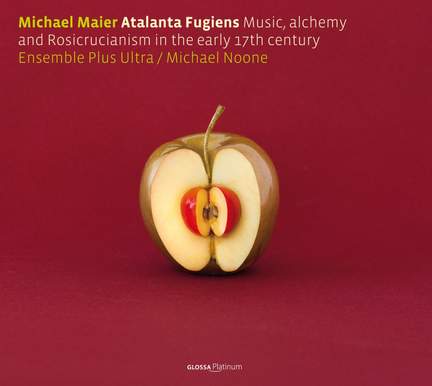
Maier, M: Atalanta Fugiens
Recorded in St Andrew’s Church, Toddington, Gloucestershire August 2008
Ensemble Plus Ultra: Grace Davidson (soprano), Clare Wilkinson (alto), Warren Trevelyan-Jones (tenor), Giles Underwood (bass), Stephen Jones (er-hu), Sue Addison (sackbut) & Marie Bournisien (Renaissance harp)
Michael Noone (direction)
The uppermost lines represent Atalanta and Hippomenes, while the cantus firmus, from a Gregorian plainsong, signifies the apples Hippomenes rolled in Atalanta’s way during their race, enabling...
Maier, M: Atalanta Fugiens
Recorded in St Andrew’s Church, Toddington, Gloucestershire August 2008
Ensemble Plus Ultra: Grace Davidson (soprano), Clare Wilkinson (alto), Warren Trevelyan-Jones (tenor), Giles Underwood (bass), Stephen Jones (er-hu), Sue Addison (sackbut) & Marie Bournisien (Renaissance harp)
Michael Noone (direction)
Purchase product
The uppermost lines represent Atalanta and Hippomenes, while the cantus firmus, from a Gregorian plainsong, signifies the apples Hippomenes rolled in Atalanta’s way during their race, enabling...
About
Atalanta Fugiens is considered by many to be the most beautiful and the most thought-provoking emblem book of all time, with an author in Michael Maier (1568-1622) who was a celebrated alchemist and physician at the court of the Emperor Rudolf II in Prague. In the final eight years of an eventful and much-travelled life, Maier created a series of illustrated alchemist works, among which Atalanta Fugiens is undoubtedly the most important.
Part of the fascination which this work has aroused stems from its tripartite nature: from a visual perspective with all its engraved emblems, as a musical work comprising 50 compositions, identified as “fugues”, which run through the publication and accompanying the images, and as a purely textual activity in the form of a volume of epigrams and alchemic commentaries. Additionally, Atalanta Fugiens provides part of the backdrop to an understanding of the spiritual Rosicrucian movement which flourished during the first decades of the 17th century, especially in the German principalities.
The musical pieces, of an extremely antiquated nature even for that time, consist of canons in two parts above a cantus firmus; Michael Noone and his Ensemble Plus Ultra perform them in their entirety and in the order in which they appear in the book. What emerges through the centuries across this book is a hypnotic disc, one that is unclassifiable yet extraordinarily evocative.
Contents and tracklist
- Ensemble Plus Ultra
- Michael Noone
Awards and reviews
 8th May 2011
The uppermost lines represent Atalanta and Hippomenes, while the cantus firmus, from a Gregorian plainsong, signifies the apples Hippomenes rolled in Atalanta’s way during their race, enabling him to pass her and win her hand in marriage. Michael Noone employs four well-blended singers, sackbut, Renaissance harp and erhu, the Chinese two-string fiddle.