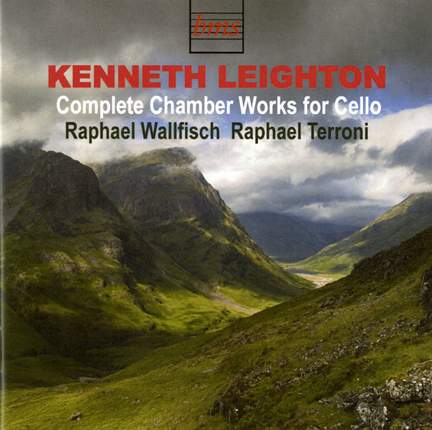
Leighton: Complete Chamber Works for Cello
Raphael Wallfisch (cello) & Raphael Terroni (piano)
This is music of impeccable craft and genuine substance, always sure of its goal and shot through with Leighton's own pungent brand of lyricism. Likewise the meaty and rewarding Sonata for solo...
Leighton: Complete Chamber Works for Cello
Raphael Wallfisch (cello) & Raphael Terroni (piano)
Purchase product
This is music of impeccable craft and genuine substance, always sure of its goal and shot through with Leighton's own pungent brand of lyricism. Likewise the meaty and rewarding Sonata for solo...
About
Kenneth Leighton wrote his first work for solo cello as a twenty-year-old student at The Queen’s College, Oxford. Completed on New Year’s Eve of 1949, the piece was a sonata in three movements in F minor and, while unfortunately not remaining intact, was the provenance of the earliest work on this disc, the Elegy for cello and piano, Op.5. Following this early work for the instrument, Leighton was to continue to write for the cello on a regular basis, with a plethora of compositions that include the instrument in various guises: as a solo instrument, with the piano, in a concerto role, in various chamber permutations as well as, inevitably, within an orchestra. This particular collection focuses on the quite substantial contribution of solo works (including those with piano) that Leighton made to the repertoire of the cello.
Contents and tracklist
- Raphael Wallfisch (cello), Raphael Terroni (piano)
- Raphael Wallfisch (cello), Raphael Terroni (piano)
- Raphael Wallfisch (cello), Raphael Terroni (piano)
Awards and reviews
 October 2011
This is music of impeccable craft and genuine substance, always sure of its goal and shot through with Leighton's own pungent brand of lyricism. Likewise the meaty and rewarding Sonata for solo cello that Leighton wrote for Joan Dickson in the summer of 1967 amply repays close scrutiny...Suffice it to report, Wallfisch and Terroni are superbly persuasive exponents
 May 2011
For all his fluency, Leighton is sometimes elusive in terms of style and idiom, on the cusp of modernism but not a true believer; yet you know you are in the hands of a true composer, and the onus is thus on the listener to go back to a piece such as [the Sonata] until it has gelled in the mind. This, thankfully, as a result of this fine disc, you can now do.