Special offer. Telemann: Harmonischer Gottes-Dienst Volume III
The cantatas for high voice, recorder and basso continuo II
Bergen Barokk: Mona Julsrud (soprano), Frode Thorsen (recorder), Hans Knut Sveen (harpsichord, organ), Thomas C. Boysen (theorbo), Markku Luolajan-Mikkola (cello)
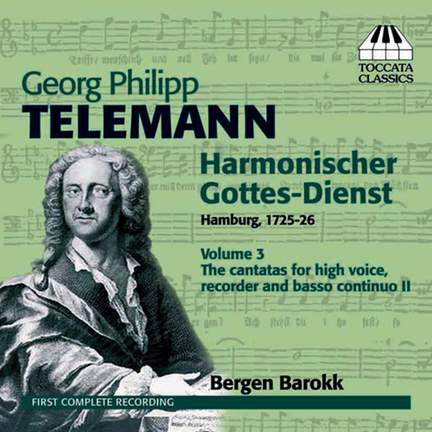
Special offer. Telemann: Harmonischer Gottes-Dienst Volume III
The cantatas for high voice, recorder and basso continuo II
Bergen Barokk: Mona Julsrud (soprano), Frode Thorsen (recorder), Hans Knut Sveen (harpsichord, organ), Thomas C. Boysen (theorbo), Markku Luolajan-Mikkola (cello)
Purchase product
About
First Recordings
This is the third volume in the highly acclaimed first complete set of recordings of the 72 cantatas from Harmonischer Gottes-Dienst, published in Hamburg in 1726.
The Harmonischer Gottes-Dienst was the first complete set of cantatas for the liturgical year ever to be published, and copies were to be found across Germany. J. S. Bach’s nephew wrote in 1758 that Telemann’s church music ‘is by now so much appreciated that there cannot be many Protestant churches in Germany where they do not perform Telemann’s annual cantata series’.
The cantatas are designed for voice, an obbligato instrument (recorder, violin, transverse flute or oboe) and basso continuo in the form of two da capo arias with an intervening recitative, and show a masterly blend of tunefulness with skilled counterpoint and vocal/instrumental virtuosity.
The reduced forces would have made them useful for performance at home as well as in church. In the churches of Telemann’s day the usual performance practice was to perform one cantata before the sermon and another one afterwards, and occasionally musicians even had to rush from church to church during the sermons, in order to meet the requirements of specific instrumentations.
Telemann also had private worship in mind when he wrote them, stating in the preface that the music is ‘more meant for private use and for domestic rather than church worship’.
Contents and tracklist
- Bergen Baroque
- Bergen Baroque
- Bergen Baroque
- Bergen Baroque
- Bergen Baroque
- Bergen Baroque
- Bergen Baroque