Rimsky Korsakov: The Tsar's Bride
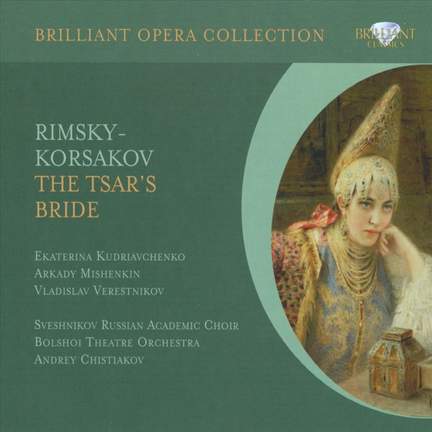
Ekaterina Kudriavchenko (Marfa), Arkady Mishenkin (Ivan Likov), Vladislav Verestnikov (Grigory Gryaznoy), Nina Terentieva (Lyubasha), Vladimir Kudriashov (Bomelius), Pyotr Gluboky (Vasily Sobakin), Elena Okolysheva (Dunyasha), Irina Udalova (Saburova), Nikolai Nizienko (Grigory Malyuta-Skuratov),...
The aria is tenderly sung by Ekaterina Kudriavchenko, who handles with great sensitivity this portrayal of a figure familiar from many Russian novels and operas, the suffering heroine. Lyubasha...
Rimsky Korsakov: The Tsar's Bride
Ekaterina Kudriavchenko (Marfa), Arkady Mishenkin (Ivan Likov), Vladislav Verestnikov (Grigory Gryaznoy), Nina Terentieva (Lyubasha), Vladimir Kudriashov (Bomelius), Pyotr Gluboky (Vasily Sobakin), Elena Okolysheva (Dunyasha), Irina Udalova (Saburova), Nikolai Nizienko (Grigory Malyuta-Skuratov),...
Purchase product
The aria is tenderly sung by Ekaterina Kudriavchenko, who handles with great sensitivity this portrayal of a figure familiar from many Russian novels and operas, the suffering heroine. Lyubasha...
About
A 100% Russian feast - An all-Russian cast in this very Russian opera of Rimsky-Korsakov, one of the finest Russian opera composers (and still neglected in this field).
A must for opera fans and everybody with a taste for dramatic, highly romantic and athmospheric music with more then a touch of couleur locale.
Very few CD competitors in this repertoire, and certainly not in this price range. Rimsky-Korsakov’s tenth opera, The Tsar’s Bride moves away from the fairytale tableauxstyle of opera in which he had triumphed. This is a grand narrative in the Verdian style. That said, the musical language is unmistakably Russian, with a motif (Slava) running like a thread throughout the score. This motto can also be heard in Boris Godunov, Beethoven’s second ‘Razumovsky’ Quartet, and Tchaikovsky’s Mazeppa. The score also displays Rimsky’s mastery of contrapuntal techniques, and of course his extraordinary use of the orchestra combine to produce a ravishing sound.
The opera, although successful in the early years of the 20th century, and throughout the early Soviet period, fell into neglect by midcentury as did most of his stage work. Galina Vishnevskaya, the great Russian soprano did much to restore the fortunes of this masterpiece with her searing interpretations of poor deranged Marfa (the wife of Ivan the Terrible). After noticing a mad woman on the streets of Leningrad after the siege, she wrote ‘I was deeply affected by her intensity and the despair of her introverted gaze. It was as if she were trying to recall something, straining to make out, in the depths of a bottomless chasm, something known to her alone.’
Artists
Ekaterina Kudriavchenko (Marfa), Arkady Mishenkin (Ivan Likov), Vladislav Verestnikov (Grigory Gryaznoy), Nina Terentieva (Lyubasha), Vladimir Kudriashov (Bomelius), Pyotr Gluboky (Vasily Sobakin), Elena Okolysheva (Dunyasha), Irina Udalova (Saburova), Nikolai Nizienko (Grigory Malyuta-Skuratov), Nina Larionova (Servant), Tatiana Pechuria (Petrovna), Vladislav Pashinsky (Coachman) & Yuri Markelov (Young Lad)
Sveshnikov Russian Academic Choir & Bolshoi Theatre Orchestra, Andrey Chistiakov
Contents and tracklist
- Vladislav Verestnikov (soloist), Nikolai Nizienko (soloist), Arkady Mishenkin (soloist), Vladimir Kudriashov (soloist), Nina Terentieva (soloist), Ekaterina Kudriavchenko (soloist), Elena Okolysheva (soloist), Tatiana Pechuria (soloist), Pyotr Gluboky (soloist), Irina Udalova (soloist), Nina Larionova (soloist), Vladislav Pashinsky (soloist)
- Bolshoi Theatre Orchestra, Sveshnikov Russian Academic Choir
- Andrey Chistiakov, Andrey Christiakov
Awards and reviews

The aria is tenderly sung by Ekaterina Kudriavchenko, who handles with great sensitivity this portrayal of a figure familiar from many Russian novels and operas, the suffering heroine. Lyubasha is potently sung by Nina Terentieva, somewhat in the
charged manner of another Marfa, that of Mussorgsky's Khovanshchina. She suggests banked fires of passion, sings her unaccompanied song caressingly, and rounds with both dignity and rage on the slimy Bomelius (Vladimir Kudriashov) even
as she consents to his advances for the sake of his potions, snarling at him the word "nemets": translated by the libretto as "monster”. Gryaznoy's opening aria is also a difficult one, for Rimsky gives him a melodic line that presents him as a
character of some sympat hy, if we do not know that he is regretting that he is now getting too old for the rapes he used to enjoy so much and is casting his eyes on the innocent Marfa instead of his mistress Lyubasha.Vladislav Verestnikov rightly
handles this with a kind of blunt strength that does not give away too much. Later, he suggests an increasing and destructive tension, while also a certain magnificence.