Ferenc Fricsay conducts Béla Bartok
The Early RIAS Recordings live & studio, 1950-53
Tibor Varga (violin), Andor Foldes (piano), Géza Anda (piano), Louis Kentner (piano), Helmut Krebs (tenor) & Dietrich Fischer-Dieskau (baritone)
RIAS-Symphonie-Orchester Berlin, RIAS Kammerchor & Chor der St. Hedwigskathedrale, Ferenc Fricsay
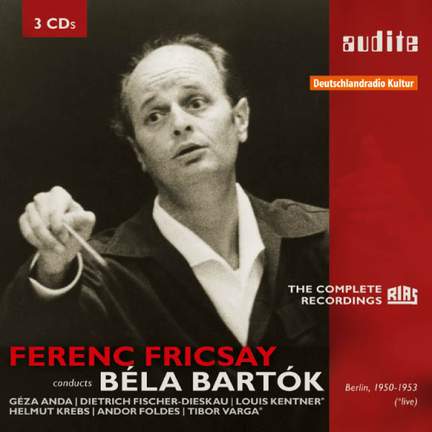
Ferenc Fricsay conducts Béla Bartok
The Early RIAS Recordings live & studio, 1950-53
Tibor Varga (violin), Andor Foldes (piano), Géza Anda (piano), Louis Kentner (piano), Helmut Krebs (tenor) & Dietrich Fischer-Dieskau (baritone)
RIAS-Symphonie-Orchester Berlin, RIAS Kammerchor & Chor der St. Hedwigskathedrale, Ferenc Fricsay
Purchase product
About
This anthology of Ferenc Fricsay’s Bartók recordings for the RIAS Berlin documents, in a three CD series, a summit meeting of famous Hungarian soloists: the pianists Géza Anda, Andor Foldes, Louis Kentner and the violinist Tibor Varga. Fricsay’s time-tested and congenial vocal soloist, once again, is Dietrich Fischer-Dieskau.
The project of a representative, possibly even complete, recording of Bartók’s oeuvre formed a part of Fricsay’s work from the beginning of his time in Berlin. These RIAS recordings feature almost exclusively Hungarian artists for the solo parts: a novelty at the time. In Fricsay’s view, Hungarian soloists were best suited to realising his precise concept of the close relationship between, on the one hand, Hungarian language and culture and, on the other, interpreting Hungarian music authentically. The only exception is Fischer-Dieskau, whom Fricsay much admired. This compilation from 1951 until 1953 includes all surviving Bartók recordings from the RIAS archives with Fricsay. It begins with opus 1, the Rhapsody for piano and orchestra (1904) and conceived in an entirely Hungarian idiom, and goes via the expressionist, agitated Deux Portraits Op 5 (1907-08) and the powerfully optimistic Dance Suite (1921) up to the masterworks of the 1930s: the neo-baroque influenced Second Piano Concerto (1930-31), the archaic, fairytale-like and darkly coloured Cantata Profana (1932), the splendid Music for Strings, Percussion and Celesta (1935), the lucid Second Violin Concerto (1937-38) and the mysterious Divertimento of 1939 with which Bartók marked the beginning of his inner farewell to Europe. Even today, more than 60 years after these recordings were made, Fricsay’s intensity is perceptible for the listener as an existential experience – both in the impetus and the positive power of the rhythm, and also in the mysteriously resigned and ironically contorted moments in this music which is so rich in nuances. This was made possible by the cooperation with other world-famous alumni of the Budapest Music Academy where Fricsay had himself studied: the pianists Géza Anda, Andor Foldes and Louis Kentner, as well as the violinist Tibor Varga. Dietrich Fischer-Dieskau joined Fricsay as a soloist in the opera Bluebeard’s Castle and the Cantata Profana. His singing (albeit in German) congenially corresponded to Fricsay’s ideal of dramatically thrilling and passionately precise Bartók interpretation.
Contents and tracklist
- Tibor Varga (violin / fiddle)
- Deutsches Symphonie-Orchester Berlin
- Ferenc Fricsay
- Rudolf Schulz (violin / fiddle)
- Deutsches Symphonie-Orchester Berlin
- Ferenc Fricsay
- Ferenc Fricsay, RIAS-Symphonie-Orchester, RIAS Kammerchor & Chor der St. Hedwigs-Kathedrale, Berlin, Dietrich Fischer-Dieskau, Ferenc Fricsay, Helmut Krebs, RIAS-Symphonie-Orchester, RIAS Kammerchor & Chor der St. Hedwigs-Kathedrale, Berlin, Dietrich Fischer-Dieskau (baritone), Helmut Krebs (tenor), Ferenc Fricsay, Helmut Krebs, RIAS-Symphonie-Orchester, RIAS Kammerchor & Chor der St. Hedwigs-Kathedrale, Berlin
- Deutsches Symphonie-Orchester Berlin, RIAS Kammerchor, Chor der St. Hedwigs-Kathedrale, Berlin
- Ferenc Fricsay