Special offer. Schoenberg, Webern, Berg: The String Quartet and the Voice
Sandrine Piau (soprano) & Marie-Nicole Lemieux (contralto)
Quatuor Diotima: Yun-Peng Zhao (violin I & II), Naaman Sluchin (violin I & II), Franck Chevalier (viola) & Pierre Morlet (cello)
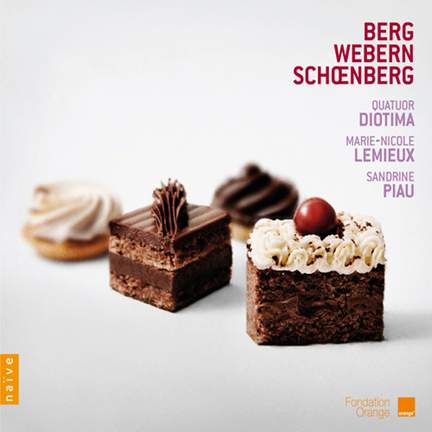
The extreme refinement and minutely focused intensity, in recordings to match, make the Webern a singularly beautiful, if somewhat unsettling experience...Marie-Nicole Lemieux's voluptuous pianissimo...
Special offer. Schoenberg, Webern, Berg: The String Quartet and the Voice
Sandrine Piau (soprano) & Marie-Nicole Lemieux (contralto)
Quatuor Diotima: Yun-Peng Zhao (violin I & II), Naaman Sluchin (violin I & II), Franck Chevalier (viola) & Pierre Morlet (cello)
Purchase product
The extreme refinement and minutely focused intensity, in recordings to match, make the Webern a singularly beautiful, if somewhat unsettling experience...Marie-Nicole Lemieux's voluptuous pianissimo...
About
For the first time all the music written for the unusual combination of string quartet and voice by the three most important composers of the Second Viennese School, Schoenberg, Webern and Berg appears together on a single CD. The music is performed by one of the best young ensembles of recent years, the Quatuor Diotima, with important contributions from the distinguished singers Sandrine Piau and Marie-Nicole Lemieux.
Founded by graduates of the Paris and Lyon conservatoires, the Diotima Quartet is a favoured partner of many contemporary composers, including Helmut Lachenmann, Brian Ferneyhough, and Toshio Hosokawa. It regularly commissions new pieces from such composers as Emmanuel Nunes and James Dillon, but it by no means neglects the classic string quartet repertoire, paying particular attention to the late quartets of Beethoven, French music, and the music of the early 20th century.
Only the first of the three works recorded here, Schoenberg’s Quartet op.10, has been regularly published since 1912. The second, a Bagatelle by Webern for string quartet with voice, was abandoned by its composer and remained unpublished. It was premiered only twenty years after his death. Berg’s Lyric Suite was published in 1927 in the form of a purely instrumental suite for string quartet. Its initial conception however contains a ‘private’ encrypted version, the existence of which was revealed only in 1977. This arrangement includes a soprano voice doubling the principal line of the last movement set to the words of a poem from Baudelaire’s Les Fleurs du Mal, ‘De Profundis Clamavi’, translated by Stefan George.
Contents and tracklist
Awards and reviews
 August 2011
The extreme refinement and minutely focused intensity, in recordings to match, make the Webern a singularly beautiful, if somewhat unsettling experience...Marie-Nicole Lemieux's voluptuous pianissimo is perfect for this paradoxically remote-revealing music. She also makes a good case for the vocal version of the finale of Berg's Lyric Suite...as for the Schoenberg: it's good to be reminded how much beauty there is in this astonishing score.
 August 2011
I certainly wouldn't argue for the vocal version [of the Lyric Suite] as a permanent replacement...But in a performance of the whole work as richly characterised and technically assured as this one by the Quatuor Diotima, I'm happy to make an exception. The quartets by Webern and Schoenberg are done with equal flair, and in Schoenberg's Second there's a rare chance to hear the peerless Sandrine Piau in post-Wagnerian vein
 6th March 2011
[Lemieux] is darkly eloquent with the long-suppressed Baudelaire text embedded in the extraordinary finale of Berg’s Lyric Suite.
 4th March 2011
The Diotima are perfectly at home in this music, cooler than some quartets in the Schoenberg and Berg but wonderful at realising all the teeming detail in both works, and the microscopic gestures of the Webern.