Special offer. Verdi: La Traviata
Maria Callas (Violetta), Cesare Valletti (Alfredo), Mario Zanasi (Giorgio Germont), Marie Collier (Flora), Forbes Robinson (Barone Douphol), Ronald Lewis (Marchese d'Obigny), Leah Roberts (Annina), Dermot Troy (Gastone), David Kelly (Dottore Grenvil)
Royal Opera House Orchestra & Chorus,...
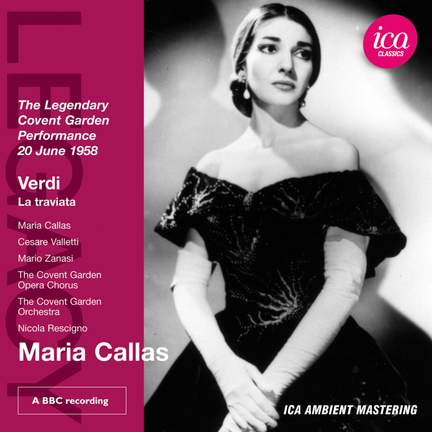
though it has been issued on various labels, this ICA Classics recording is the best I have heard...after Act 1, in which [Callas] still does many wonderful things, her performance is on a level...
Special offer. Verdi: La Traviata
Maria Callas (Violetta), Cesare Valletti (Alfredo), Mario Zanasi (Giorgio Germont), Marie Collier (Flora), Forbes Robinson (Barone Douphol), Ronald Lewis (Marchese d'Obigny), Leah Roberts (Annina), Dermot Troy (Gastone), David Kelly (Dottore Grenvil)
Royal Opera House Orchestra & Chorus,...
Purchase product
though it has been issued on various labels, this ICA Classics recording is the best I have heard...after Act 1, in which [Callas] still does many wonderful things, her performance is on a level...
About
Maria Callas (1923-1977) needs no introduction as she was quite simply one of the greatest singers of the 20th century. Any recording is of major importance and this Traviata from 1958 given in London’s Royal Opera House, Covent Garden is no exception.
Peter Heyworth in the Observer commented, ‘it was a performance of outstanding distinction and musicality, full of details that illuminated again and again the part as though for the first time’.
Opera News said, ‘there must have been many Verdi lovers who felt at last that they had come face to face with Violetta herself...’
John Ardoin in his book The Callas Legacy was very enthusiastic about the performance, not only Callas but also the Germont of Mario Zanasi for example, ‘Zanasi’s intrinsic musicality combined with Callas’s wealth of insights to bring the lengthy second act scene between Germont and Violetta to a living realisation. This duet is a study in contrasts, tensions and releases on the highest expressive level’.
Of Callas herself, Ardoin went on to say ‘it is in the final Act that Callas makes the tragedy of Violetta most immediate. The opening recitatives and “Addio del passato” are from another world…Callas’ Violetta is summed up in the strain “Se una pudica vergine” sung in a half-lit legato of breathtaking eloquence’. Ardoin praised the conductor Nicola Rescigno who ‘brings sanity and song to the performance and was remarkably at one with Callas in the ends she sought’.
This recording drawn from private tapes has been remastered by Paul Baily using ICA’s Ambient Mastering process which has enhanced and widened the sound considerably. Here is his description: “Our Ambient Remastering process creates a sense of space and width to a mono, or very narrow stereo, recording. No artificial reverberation is added in this process, so that it remains faithful to the natural acoustic of the original”.
Artists
Maria Callas (Violetta), Cesare Valletti (Alfredo), Mario Zanasi (Giorgio Germont), Marie Collier (Flora), Forbes Robinson (Barone Douphol), Ronald Lewis (Marchese d'Obigny), Leah Roberts (Annina), Dermot Troy (Gastone), David Kelly (Dottore Grenvil)
Royal Opera House Orchestra & Chorus, Nicola Rescigno
Contents and tracklist
- Maria Callas (soprano), Marie Collier (soprano), Lea Roberts (mezzo-soprano), Cesare Valletti (tenor), Mario Zanasi (baritone), Dermot Troy (tenor), Forbes Robinson (bass), Ronald Lewis (baritone), David Kelly (bass)
- Royal Opera House Chorus, Covent Garden, Royal Opera House Orchestra, Covent Garden
- Nicola Rescigno
Awards and reviews
 May 2011
though it has been issued on various labels, this ICA Classics recording is the best I have heard...after Act 1, in which [Callas] still does many wonderful things, her performance is on a level which no other soprano compares with. The scene with Germont is overwhelming, and her immense affirmation of love to Alfredo is almost unbearably intense...This is art at its absolute limit, and a unique document.
 20th March 2011
Maria Callas's Violetta was one of the wonders of our age: scarily elemental, supernaturally brilliant...Callas sounds less full-voiced, more restrained, than in her 1958 Lisbon performance, but the combination of vocal depth and fragile, eloquent virtuosity is unbeatable and the emotional collapse across the three acts is heartbreaking...Nicola Rescigno's conducting lifts the performance to the highest level. A classic indeed.