Liszt: Funeral Odes
BBC Scottish Symphony Orchestra, Ilan Volkov
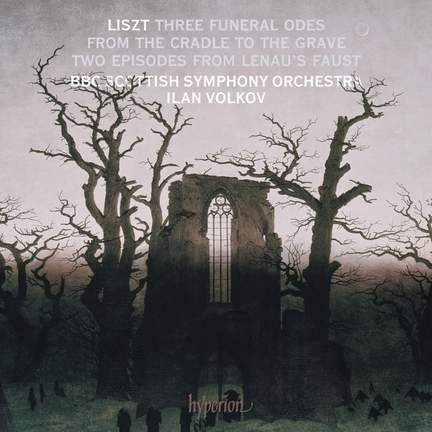
Awards:
-
BBC Music Magazine, April 2011, Orchestral Choice

Volkov shapes all these pieces with what seems perfect understanding of their different shades of gloom or grief, and the playing of the BBC Scottish, helped by Hyperion's first-rate recording,...
Liszt: Funeral Odes
BBC Scottish Symphony Orchestra, Ilan Volkov
Purchase product
Awards:
-
BBC Music Magazine, April 2011, Orchestral Choice
Volkov shapes all these pieces with what seems perfect understanding of their different shades of gloom or grief, and the playing of the BBC Scottish, helped by Hyperion's first-rate recording,...
About
As part of Liszt’s anniversary year Hyperion turns to some of the composer’s most underrecorded and underperformed works. Liszt’s piano music is so much in the foreground that his works for orchestra have been almost forgotten. Here we present a fascinating selection.
Liszt’s Trois Odes funèbres were composed between 1860 and 1866, and exist in a variety of versions: for orchestra, for piano solo and for piano duet. There is also a chorus in the first Ode and the possibility of a narrator in the first and second. The first is also an organ piece, with the title Trauerode, and La notte also exists for violin and piano. The third of the Odes is also entitled ‘Epilogue to the Symphonic Poem: Tasso, Lamento e Trionfo’, and in its orchestral version it enjoyed a certain vogue towards the end of the nineteenth century. Although it is quite clear from the original manuscripts that Liszt intended these works to be performed as a cycle, they have never been published together and have rarely been performed as he wished. This is the first recording of the complete set.
‘From the cradle to the grave’ was written after a drawing by the Hungarian artist Mihály Zichy (1827–1906) depicting three stages of existence: birth; the struggle for being; and death, the cradle of the life to come.
The Faust legend preoccupied Liszt for much of his life, and inspired the composer’s most famous orchestral work, the Faust Symphony. However Zwei Episoden aus Lenaus Faust also contains some of the composer’s most thrillingly atmospheric music.
Contents and tracklist
Awards and reviews
-
BBC Music MagazineApril 2011Orchestral Choice
 April 2011
Volkov shapes all these pieces with what seems perfect understanding of their different shades of gloom or grief, and the playing of the BBC Scottish, helped by Hyperion's first-rate recording, is also perfectly attuned to the light and shade of Liszt's sound-palette. Altogether a revelatory album: this combination of works actually says something new about Liszt's quality as an orchestral composer.
 May 2011
Volkov, aided by superior engineering, offers a... detailed account: witness the precision of the suave Scottish string section in the opening of "Der Kampf um's Dasein" with the important figure in the brass that succeeds it generating added tension.
 March 2011
Volkov does not disappoint in bringing out the sombre fatalism but also the inward serenity of the music...[in Trois Odes funèbres] Volkov (aided by a rapt response from the men of the Glasgow Singers) delves that much deeper into music whose long-term influence is out of all proportion to its present-day unfamiliarity.
 27th March 2011
From the Cradle to the Grave... is strikingly beautiful, its impacted tripartite structure...exceedingly direct but memorably effective...This vivid account, on a disc with the equally rare Three Funeral Odes and Two Episodes from Lenau’s Faust (the second the famous Mephisto Waltz), should do something for his standing in his bicentenary year.
 11th March 2011
The performances are tremendous. Volkov turns out to be a superb Lisztian, alert to the music's anguish and exaltation. The playing is beautifully textured, with a strong sense of technical and emotional limits being broached and sustained throughout. Highly recommended.