Special offer. Ben Johnston: Ponder Nothing & Other Works
Music Amici
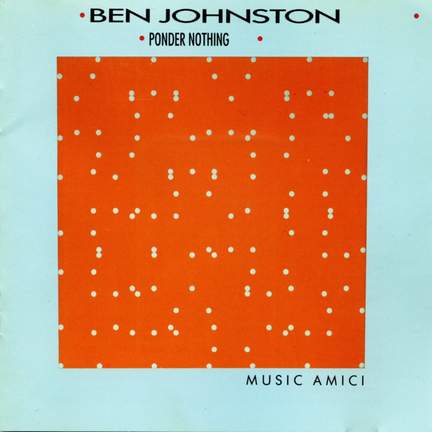
Special offer. Ben Johnston: Ponder Nothing & Other Works
Music Amici
Purchase product
About
Ben Johnston's (b 1926) music shows the confluence of several traditions of music-making that have flourished within the United States. In the 1950s his output was characterized by the neoclassicism of his teacher Darius Milhaud. In the 1960s he explored serial techniques and, at the end of the decade, indeterminacy. From 1960 onward the overriding technical preoccupation of his music has been its use of just intonation, the tuning system of the music of ancient cultures as well as that of many living traditions worldwide. The six works represented on this disc span Johnston's journey through atonality, neoclassicism, serial technique, and finally, his pioneering use of just intonation.
Septet (1956-58) for woodwind quintet with cello and contrabass, marks the height of Johnston's early neoclassic period. Debts to Stravinsky—recurring structural figures, ostinatos that repeat pitches in unpredictable rhythms-are obvious. The more direct influence of Johnston's first important teacher, Darius Milhaud, is apparent in the bitonal textures.
In his 1955 Three Chinese Lyrics, scored for soprano and two violins, Johnston has set three poems by the Chinese T'ang dynasty poet Li Po (701-762) in translations by Ezra Pound (his early mentor Harry Partch already had set seventeen of the poems; Johnston set the remaining three).
Commissioned by choreographer Merce Cunningham, Gambit (1959) is scored for twelve instruments and consists of six movements, three of which-Interlude 1, Prelude 2, and Interlude 2-use twelve-tone rows. Gambit, a mixed-genre work, precipitated the crucial decision of Johnston's career, his switch to extended "just intonation."
For most composers, just intonation implies tonality, but Johnston is unique for his works that fuse pure tuning with the twelve-tone system including Five Fragments (1960). Fragments 1, 2, 3, and 5 modulate systematically from one twelve-tone row to another and, here and in general, Johnston's early just intonation counterpoint moves carefully among consonant intervals.
A much later work, Trio for clarinet, violin, and cello (1982), is a gem of Johnston's mature style, rhythmically engaging and harmonically subtle. Phrases return, sometimes with altered continuations, or transposed to different pitch levels, or using an undertone scale rather than an overtone scale. As a result, and typical of Johnston's late work, the Trio's lithe counterpoint falls sweetly on the ear; the complexity is below the surface.
Ponder Nothing (1989), is a set of solo clarinet variations on the traditional French hymn "Let All Mortal Flesh Keep Silence." If the hymn gives voice to Johnston's Catholicism, the title, taken from the hymn's third line-"Ponder nothing earthly minded"-refers to his interest in the no-mind meditation of Zen.
Contents and tracklist
- Music Amici
- Charles Yassky
- Dora Ohrenstein
- Music Amici
- Charles Yassky
- Music Amici
- Charles Yassky
- Stephen Kalm
- Music Amici
- Charles Yassky
- Music Amici
- Charles Yassky
- Charles Yassky