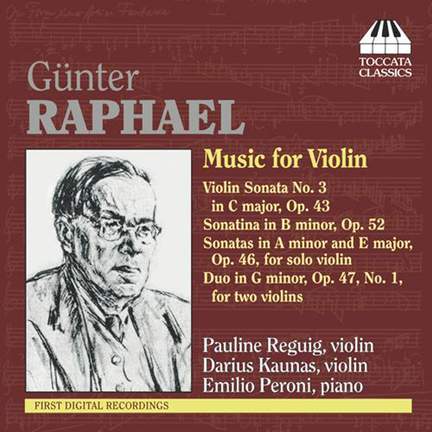
Special offer. Günter Raphael: Music for Violin
First Recordings on CD
Pauline Reguig (violin), with Emilio Peroni (piano), with Darius Kaunas (violin)
I am convinced that the music's inherent humanity, depth of feeling, warmth and optimism will endure long after the more fashionable example of Raphael's (and our own) contemporaries have fallen...
Special offer. Günter Raphael: Music for Violin
First Recordings on CD
Pauline Reguig (violin), with Emilio Peroni (piano), with Darius Kaunas (violin)
Purchase product
I am convinced that the music's inherent humanity, depth of feeling, warmth and optimism will endure long after the more fashionable example of Raphael's (and our own) contemporaries have fallen...
About
Günter Raphael (1903–60) was a composing prodigy whose First Symphony was premiered by Furtwängler at the age of only 23. His music was also championed by the Busch Quartet, and he became one of the youngest professors at the Leipzig Conservatoire.
In 1934 he was declared a ‘half-Jew’ by the Nazis and was forced from his teaching position in Leipzig, moving to Meiningen where his wife, a pianist, held a teaching position.
In 1937 he caught tuberculosis – which, paradoxically, was to be the saving of him: confined to hospital during the War years, he continued to compose while his doctors protected him from persecution. After the war he went back to teaching and ended as professor at the Cologne Musikhochschule, before finally succumbing to the disease which he had fought for so long.
Stylistically his music lies in the mainstream of German Romanticism as refracted through Hindemith. These violin works are strongly melodic and rhythmically vital; the two solo sonatas have echoes of Bach.
Contents and tracklist
- Pauline Reguig, Emilio Peroni
- Pauline Reguig
- Pauline Reguig, Darius Kaunas
- Pauline Reguig
- Pauline Reguig, Emilio Peroni
Awards and reviews
 March 2011
I am convinced that the music's inherent humanity, depth of feeling, warmth and optimism will endure long after the more fashionable example of Raphael's (and our own) contemporaries have fallen into deserved oblivion...One can sense that these gifted artists play this music with obvious inner conviction. This is a fascinating and, no doubt, in its way, important issue.
 15th May 2014
The solo sonatas are fascinating examples of Raphael’s surety in writing for the instrument, refined and purposeful in slower passages, and more acrid and angular in the faster ones. The writing sits somewhere between the violin music of Reger and Karl Amadeus Hartmann.