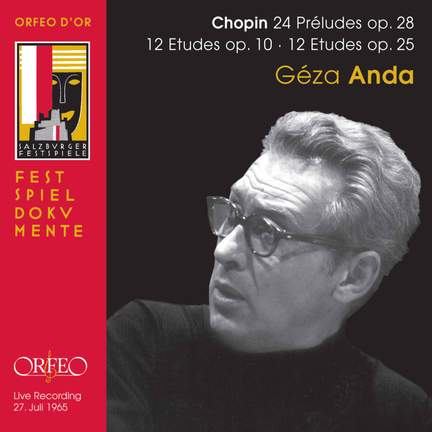
Géza Anda plays Chopin
Mozarteum 27/7/1965
Géza Anda (piano)
the "Black Key" is bouncy and well-characterised, No. 6's melody and tenor accompaniment exquisitely shaded, the left-hand arpeggios of the "Revolutionary" articulated to the proverbial nines,...
Géza Anda plays Chopin
Mozarteum 27/7/1965
Géza Anda (piano)
Purchase product
the "Black Key" is bouncy and well-characterised, No. 6's melody and tenor accompaniment exquisitely shaded, the left-hand arpeggios of the "Revolutionary" articulated to the proverbial nines,...
About
Sensational: a first recording by Géza Anda of Chopin’s 12 Etudes Op. 10. He once said of Op. 10 No. 1 that you have to have been a pianist for 25 years before you can play it. The Hungarian pianist Géza Anda (1921–76) was a celebrated interpreter of classical and romantic repertoire. Particularly noted for his performances and recordings of Mozart, he was also a tremendous interpreter of Beethoven, Schumann, Brahms and Bartók. In his heyday he was regarded as an amazing artist, possessed of a beautiful, natural and flawless technique that gave his concerts a unique quality. But since his death in 1976 at the age of fifty-four, his high reputation has faded somewhat from view.
Contents and tracklist
- Géza Anda
- Recorded: 27 July 1965
- Recording Venue: Österreichischen Rundfunks 1, Solistenkonzert, Mozarteum, Austria
- Géza Anda
- Recorded: 27 July 1965
- Recording Venue: Österreichischen Rundfunks 1, Solistenkonzert, Mozarteum, Austria
- Géza Anda
- Recorded: 27 July 1965
- Recording Venue: Österreichischen Rundfunks 1, Solistenkonzert, Mozarteum, Austria
Awards and reviews
 December 2010
the "Black Key" is bouncy and well-characterised, No. 6's melody and tenor accompaniment exquisitely shaded, the left-hand arpeggios of the "Revolutionary" articulated to the proverbial nines, while Nos. 9 and 10 boast impressive textural differences.