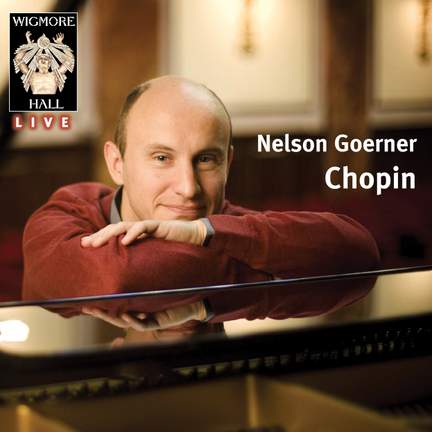
Nelson Goerner - Chopin
Recorded live at Wigmore Hall, London 1 October 2009
Nelson Goerner (piano)
Awards:
-
BBC Music Magazine, December 2010, Instrumental Choice

The equilibrium he achieves between formality (polonaise) and extemporisation (fantasy) is exemplary. So are the breadth, refinement and deployment of his impeccably Chopinesque tonal palette....
Nelson Goerner - Chopin
Recorded live at Wigmore Hall, London 1 October 2009
Nelson Goerner (piano)
Purchase product
Awards:
-
BBC Music Magazine, December 2010, Instrumental Choice
The equilibrium he achieves between formality (polonaise) and extemporisation (fantasy) is exemplary. So are the breadth, refinement and deployment of his impeccably Chopinesque tonal palette....
About
The Argentinian pianist Nelson Goerner, whose Chopin playing has prompted Gramophone to describe him as ”a player of exalted poetic verve”, celebrated the bicentenary of Chopin’s birth with a major series of performances of his music, including this Wigmore Hall concert last October. His recital begins with Chopin’s last large-scale work, the Polonaise-Fantaisie, one of Goerner’s favourite pieces by Chopin, which he regards as among his greatest and most visionary works. “This is one of the peaks of Chopin’s last years, belonging to the series of masterpieces he wrote towards the end of his life when he was at his most daring and harmonically imaginative”, Goerner says.
He ended the first part of this Wigmore Hall recital with the Grande Polonaise, which Chopin wrote in 1830 during his final months in Poland, adding the Andante spianato five years later to play at one of his concerts in Paris. Chopin composed his Études Op. 10 around the time of the Grande Polonaise, when he was in his early twenties.
For his encores Goerner turned first to another composer with whose music he is particularly associated, Sergei Rachmaninov, who was such a great admirer of Chopin and was strongly influenced by his music. The second encore returns to Chopin and the last of his Preludes, the D minor, once famously described as ‘blood, voluptuousness and death’.
The name Nelson Goerner is already firmly established as one of the most remarkable pianists of his generation. Following a meeting with Martha Argerich, he received a scholarship which enabled him to travel to Europe, where his meeting with Maria Tipo - the other key influence on his musical life - took place. Since then, Nelson Goerner has given recitals in the world’s most prestigious concert halls; he has been invited to many festivals including Lucerne, La Roque d’Anthéron, La Grange de Meslay (where he replaced Sviatoslav Richter at a moment’s notice), BBC Proms, Aldeburgh and Salzburg. Future appearances include return invitations to the Verbier and Schleswig-Holstein festivals, as well as recitals in Paris, Geneva, Warsaw and Buenos Aires.
CONCERT REVIEW:
“Everything about Goerner’s playing of the Opus 10 set revealed his finely balanced, secure and non-showy musicianship [and] his formidable technique... This was very impressive playing – flawlessly even arpeggios in No.1, a wonderful legato and unusual sense of perspective in No.3, fantastically rapid and defined finger work in No.4, a surprising outburst of high spirits to rival Cortot (but without the mistakes) in No.8, and a fearlessly tempestuous ‘Revolutionary’. “Goerner’s range of colour and touch, allied to clarity of technique and discretion of temperament, puts him on a par with the great Chopin pianists.” Classical Source, October 2009
Contents and tracklist
Awards and reviews
-
BBC Music MagazineDecember 2010Instrumental Choice
 December 2010
The equilibrium he achieves between formality (polonaise) and extemporisation (fantasy) is exemplary. So are the breadth, refinement and deployment of his impeccably Chopinesque tonal palette. These virtues pervade the entire recital, in which high drama, psychological intensity and a Shakespearean range are conveyed without a hint of excess.
 November 2010
The Op. 62 Nocturnes are characterised by freedom, flexibility and more than a few "old school" instances of the left hand anticipating the right...Goerner largely projects a powerful, singing legato through fingerwork and hand position.
 9th September 2010
Technically, it's a tour de force; emotionally, it's an inexorable rollercoaster ride into a turbulence that the temporary contemplation of passion (the famous third Étude in E major) or optimism (No 5 in G flat) seems unable to forestall.It forms the climax of a disc that gives us a darker Chopin than usual and defines him as poetic and introverted
 2nd September 2010
...he plays works that are central to the Chopin repertoire, but he brings to them an exceptional sense of intimate involvement with their harmonic as well as their technical intricacies...Goerner communicates an essential spark of musicality.