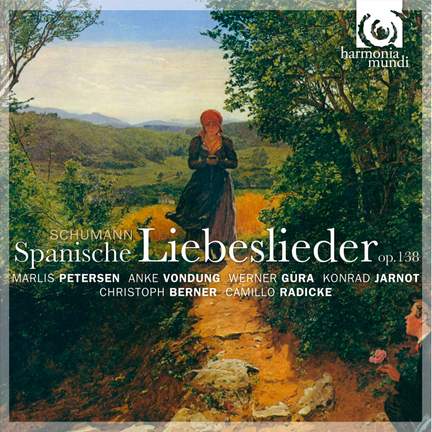
Schumann: Spanische Liebeslieder
Marlis Petersen (soprano), Anke Vondung (mezzo soprano), Werner Güra (tenor), Konrad Jarnot (baritone) & Christoph Berner, Camillo Radicke (pianos)
Christoph Berner and Camillo Radicke animate proceedings with rhythmic guile and point, a refined sense of texture, and, in the more obviously "Spanish" numbers, a palpable sense of enjoyment...the...
Schumann: Spanische Liebeslieder
Marlis Petersen (soprano), Anke Vondung (mezzo soprano), Werner Güra (tenor), Konrad Jarnot (baritone) & Christoph Berner, Camillo Radicke (pianos)
Purchase product
Christoph Berner and Camillo Radicke animate proceedings with rhythmic guile and point, a refined sense of texture, and, in the more obviously "Spanish" numbers, a palpable sense of enjoyment...the...
About
The year 1849 was one of Schumann's most prolific. The inspiration for his Opp.74 and 138 was an anthology of Spanish texts translated by Emanuel Geibel. These short love poems were ideal material for music in the tangy ‘Spanish' style tinged with the colours of central Europe. Considerably more intimate, the Minnespiel Op.101 takes us from storybook Spain to German Romanticism.
Contents and tracklist
- Marlis Petersen, Anke Vondung, Christoph Berner, Werner Güra, Konrad Jarnot
- Werner Güra, Camillo Radicke, Marlis Petersen, Anke Vondung, Konrad Jarnot
- Christoph Berner, Camillo Radicke, Marlis Petersen, Anke Vondung, Werner Güra, Konrad Jarnot
Awards and reviews
 November 2010
Christoph Berner and Camillo Radicke animate proceedings with rhythmic guile and point, a refined sense of texture, and, in the more obviously "Spanish" numbers, a palpable sense of enjoyment...the prime recommendation for these delectable, and still undervalued, Liederspiele.
 29th August 2010
The quartets are an especial delight, unjustly neglected treats for the Schumann bicentenary.
 19th August 2010
They are mostly modest little songs about love and loss, but as these performances – done with just the right light touch – show, the sequences are both touching and charming, and just occasionally find the expressive vein that yielded some of Schumann's greatest songs nine years earlier.