Special offer. Cage: Etudes Boreales
Friedrich Gauwerky (cello) & Mark Knoop (piano)
[Knoop] plays a new idea of virtuosity. Where to pluck that string exactly, hit the wooden frame exactly; how to place those isolated, out-of-context chords on a keyboard for maximum impact...
Special offer. Cage: Etudes Boreales
Friedrich Gauwerky (cello) & Mark Knoop (piano)
Purchase product
[Knoop] plays a new idea of virtuosity. Where to pluck that string exactly, hit the wooden frame exactly; how to place those isolated, out-of-context chords on a keyboard for maximum impact...
About
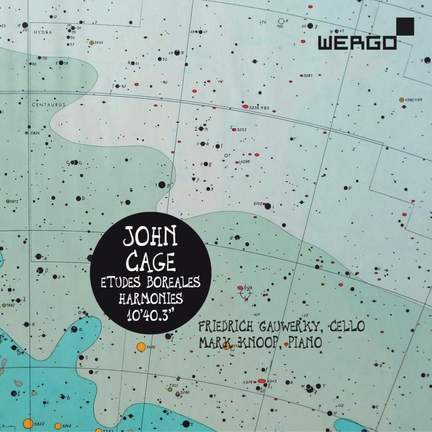
Enormous technical requirements make the Cage's Etudes Boreales a highly virtuosic work, which requires an extreme sensitivity of feeling for the coordination of fingers, instrument, and intellect. On this CD it is presented in versions: for piano solo and later for cello solo with piano solo. As in the sister works, Etudes Australes and Freeman Etudes, Cage based the Etudes Boreales on a star chart. He used the chart of the northern sky that the Czech astronomer Antonín Becvár made in 1962. The time length piece 26'1.1499'' – Friedrich Gauwerky chooses the first 640.3 seconds for this recording – documents the composer’s retreat from an intentional determination of the sounds. And also the Harmonies welcome the creative possibilities of whatever happens next.
Contents and tracklist
- Friedrich Gauwerky, Mark Knoop
- Friedrich Gauwerky, Mark Knoop
- Friedrich Gauwerky, Mark Knoop
- Friedrich Gauwerky, Mark Knoop
- Friedrich Gauwerky, Mark Knoop
- Friedrich Gauwerky, Mark Knoop
- Friedrich Gauwerky, Mark Knoop
- Friedrich Gauwerky, Mark Knoop
- Friedrich Gauwerky, Mark Knoop
- Friedrich Gauwerky, Mark Knoop
- Friedrich Gauwerky, Mark Knoop
- Friedrich Gauwerky, Mark Knoop
- Friedrich Gauwerky, Mark Knoop
Awards and reviews
 October 2010
[Knoop] plays a new idea of virtuosity. Where to pluck that string exactly, hit the wooden frame exactly; how to place those isolated, out-of-context chords on a keyboard for maximum impact - each sound first felt, then diligently executed and heard.
 24th June 2010
[The two performances] are very different and both are extraordinary, constantly drawing the ear into the minutiae of the sounds: isolated, lingering events in Mark Knoop's piano-solo version; more continuous with the involvement of Friedrich Gauwerky's cello.