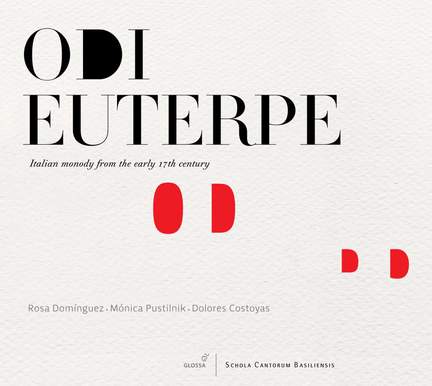
Odi Euterpe
Italian monody in the early 17th century
Rosa Domínguez (mezzo), Mónica Pustilnik (archlute, Renaissance guitar & organ) & Dolores Costoyas (theorbo & Baroque guitar)
Rosa Dominguez has an attractively light and lyrical voice, warm in the middle register and bright in the upper one. Her phrasing is sensitive and improvised ornamentation in an appropriate...
Odi Euterpe
Italian monody in the early 17th century
Rosa Domínguez (mezzo), Mónica Pustilnik (archlute, Renaissance guitar & organ) & Dolores Costoyas (theorbo & Baroque guitar)
Purchase product
Rosa Dominguez has an attractively light and lyrical voice, warm in the middle register and bright in the upper one. Her phrasing is sensitive and improvised ornamentation in an appropriate...
About
LUXURY DIGIPACK 56pp booklet.
Recorded in Santa Giulia in Caprona, Pisa, September 2008
Seldom ever have ‘new musics’ demonstrated the freshness and boldness as shown at the beginning of the 17th century. In 1602 Giulio Caccini proposed, in the essay prefacing his Le Nuove Musiche, a new relationship between music and text; this could be summed up in the term sprezzatura, according to which the text moves to a primary position of importance. In combination with the emergent basso continuo, Caccini thus sowed the seed for the startling development of vocal genres in subsequent centuries.
This recording presents various facets of the new vocal art, beginning with works by Caccini himself, moving via stylish composers such as Girolamo Frescobaldi or the madrigalian miracles of Sigismondo d’India to exhilarating works by the poet-composer Benedetto Ferrari, active in Venice and Vienna in the middle of the 17th century.
Rosa Domínguez interprets these works placing special emphasis on the text, prominently and enthusiastically stressing the ‘I’ of these poetic creations, generally the victim of amorous sufferings. The plentiful stanzas of these songs, dressed by an extremely flexible and imaginative basso continuo permit the telling of complete stories. By utilising a limited means of support (just the two plucked strings instruments), the full deployment of vocal expressivity is encouraged, bringing into existence as a result new musical spaces in the line of what was imagined by Caccini and his ‘nuove musiche’.
Contents and tracklist
- Monica Pustilnik (guitar), Rosa Dominguez (mezzo-soprano), Dolores Costoyas (theorbo)
- Dolores Costoyas (theorbo)
- Rosa Dominguez (mezzo-soprano), Monica Pustilnik (archlute)
- Monica Pustilnik (archlute)
- Rosa Dominguez (mezzo-soprano), Monica Pustilnik (archlute), Dolores Costoyas (theorbo)
- Rosa Dominguez (mezzo-soprano), Monica Pustilnik (archlute)
- Rosa Dominguez (mezzo-soprano), Dolores Costoyas (theorbo), Monica Pustilnik (organ)
- Rosa Dominguez (mezzo-soprano), Dolores Costoyas (theorbo), Monica Pustilnik (organ)
- Dolores Costoyas (theorbo), Rosa Dominguez (mezzo-soprano), Monica Pustilnik (archlute)
- Rosa Dominguez (mezzo-soprano), Dolores Costoyas (theorbo), Monica Pustilnik (archlute)
- Monica Pustilnik (archlute)
- Rosa Dominguez (mezzo-soprano), Dolores Costoyas (theorbo)
- Monica Pustilnik (guitar), Dolores Costoyas (baroque guitar)
- Rosa Dominguez (mezzo-soprano), Monica Pustilnik (archlute), Dolores Costoyas (theorbo)
Awards and reviews
 April 2011
Rosa Dominguez has an attractively light and lyrical voice, warm in the middle register and bright in the upper one. Her phrasing is sensitive and improvised ornamentation in an appropriate style has been discreetly and thoughtfully added...Altogether a delightful advocate for some forgotten masterpieces.