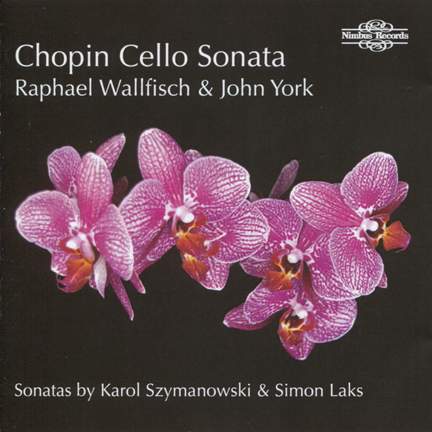
Chopin - Cello Sonatas
Raphael Wallfisch (cello) & John York (piano)
Awards:
-
Gramophone Magazine, September 2010, Editor's Choice

First up is the famous Chopin, which in Wallfisch's hands flows like a river of silk, pulsing with a burnished warmth, spontaneity and vigour. His long partnership with York is shown at its...
Chopin - Cello Sonatas
Raphael Wallfisch (cello) & John York (piano)
Purchase product
Awards:
-
Gramophone Magazine, September 2010, Editor's Choice
First up is the famous Chopin, which in Wallfisch's hands flows like a river of silk, pulsing with a burnished warmth, spontaneity and vigour. His long partnership with York is shown at its...
About
Chopin’s name inevitably dominates this line-up of Polish composers, especially in this bi-centenary year of 2010 when every note of his is being re-explored. Certain works of the prolific but short-lived Szymanowski, particularly his two violin concertos and the concert pieces for violin and piano, maintain their popularity internationally but that leaves so much still to be discovered. And the name of Simon Laks is only just beginning to emerge from oblivion. His cello sonata here receives its first recording.
Simon Laks wrote his Sonata in the early 1930s expressly for the great French cellist Maurice Maréchal. The piano part was first played by Vlado Perlemuter in 1932, the partnership a testimony to the composer’s standing in the city. The piece remains to this day in the hand-writing of Laks, uncorrected but very readable. The 1930s’ musical scene in Paris was dominated by the likes of Ravel, Poulenc and Honegger – and Gershwin - and the influence of each can be glimpsed in the writing. The night-club atmosphere of the central movement is indebted to Ravel’s ‘Blues’ movement in his violin sonata (same key, same smoky sleaziness). Strict sonata form serves Laks well in the first movement, the second subject almost Fauré-esque in its delicious, side-stepping harmony. Had he not been removed so cruelly from the forefront of music and sent to the concentration camp, who knows what wonderful scores he might have composed later? Instead, he turned to film music and a rather more hum-drum life of obscurity from which, 30 years after his death, he is only now beginning to come to the public’s attention.
Contents and tracklist
- Raphael Wallfisch, John York
- Raphael Wallfisch, John York
- Raphael Wallfisch, John York
- Raphael Wallfisch, John York
Awards and reviews
-
Gramophone MagazineSeptember 2010Editor's Choice
 August 2010
First up is the famous Chopin, which in Wallfisch's hands flows like a river of silk, pulsing with a burnished warmth, spontaneity and vigour. His long partnership with York is shown at its best, instinctive and flexible...Their soulful reading of Glazunov's transcription of the E flat Etude is one to cherish.
 September 2010
There's an air of spontaneity, yet the expressive weight of each phrase is carefully considered, by York as well as by Wallfisch, giving the whole work a powerful sense of unity...Their grand gestures [in the Szymanowski] carry complete conviction and sweep us along.