Thomas Larcher: Madhares
Till Fellner (piano), Kim Kashkashian (viola)
Munich Chamber Orchestra, Quatuor Diotima, Dennis Russell Davies
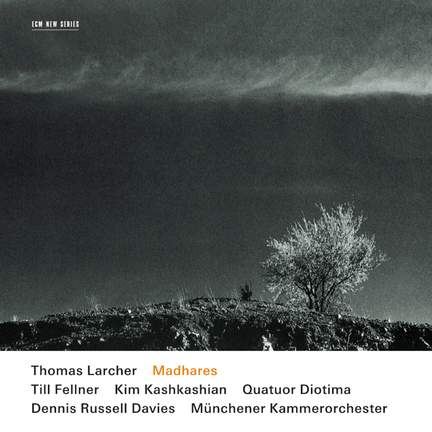
He has a fabulous ear for unusual sonorities, which he fashions into surprisingly logical narratives...Böse Zellen, in particular, is a truly original work, vigorously performed and captured...
Thomas Larcher: Madhares
Till Fellner (piano), Kim Kashkashian (viola)
Munich Chamber Orchestra, Quatuor Diotima, Dennis Russell Davies
Purchase product
He has a fabulous ear for unusual sonorities, which he fashions into surprisingly logical narratives...Böse Zellen, in particular, is a truly original work, vigorously performed and captured...
About
Top musicians from ECM’s artist roster, pianist Till Fellner and viola player Kim Kashkashian among them, deliver both fiery and sensitive interpretations of new, mainly orchestral works by Thomas Larcher. It’s the third ECM disc exclusively devoted to the Austrian composer who juxtaposes tonal harmony and avant-garde compositional technique in most original ways.
Larcher’s recent pieces are marked by intense sonic imagination, great rhythmic energy and a virtuoso impact that makes for immediately rewarding listening. This recording features Böse Zellen and Still, respectively piano and viola concertos performed by Till Fellner and Kim Kashkashian with the Munich Chamber Orchestra conducted by Dennis Russell Davies. The disc is enhanced by his third string quartet Madhares which is played by the youthful French Quatuor Diotima in their ECM debut.
The creative output of Thomas Larcher (born in Innsbruck in 1963) - whom The Times recently called “a musical talent of unbounded sensitivity and distinction bound for 21st-century glory” - has been championed on ECM New Series since 2001. His earliest compositions date from childhood. After studying in Vienna he embarked on a successful career as a concert pianist with a particular focus on new music. Heinz Holliger, Dennis Russell Davies and Manfred Eicher were amongst the friends and colleagues who encouraged Larcher to pursue composition further. Following early forays into piano music – some of which he performed himself on the CD Naunz (2001, 4617182) – he moved on to larger items of chamber music (Ixxu; 2006, 4763156), which in turn have led, over the years, to orchestral music and concertante compositions. Last autumn Larcher’s piano piece “What becomes” attracted wide-spread attention when premiered by Leif Ove Andsnes.
Contents and tracklist
- Till Fellner (piano)
- Munich Chamber Orchestra
- Dennis Russell Davies
- Recorded: 2008-08-27
- Recording Venue: Bavaria Musikstudios, München
- Kim Kashkashian (viola), Thomas Larcher (piano)
- Munich Chamber Orchestra
- Dennis Russell Davies
- Recorded: 2008-08-27
- Recording Venue: Bavaria Musikstudios, München
- Quatuor Diotima (stringquartet), Naaman Sluchin (violin), Yun Peng Zhao (violin), Frank Chevalier (viola), Pierre Morlet (cello)
- Recorded: 2009-07-21
- Recording Venue: Liederkranzhalle, Stuttgart
Awards and reviews
 September 2010
He has a fabulous ear for unusual sonorities, which he fashions into surprisingly logical narratives...Böse Zellen, in particular, is a truly original work, vigorously performed and captured in flawless sound.
 Awards Issue 2010
The performances are clean and precise; one expects this from the soloists, who acquit themselves very honourably, but also worth mentioning are the string ensembles in the concertos, which manage to oppose the soloists very effectively, and the assured confidence and élan of the Quatuor Diotima.
 July/August 2010
...the sum of the parts, disjunct and isolated as they seem at close quarters, is a surprisingly coherent and assured work in which there is not just a finished sense of structure but also a real depth of expression...this journey to nowhere is profoundly rewarding.
 6th May 2010
Larcher ranges very widely in his influences, and most often well away from the mainstream of European music in the last 30 years...The romantic gestures and moments of frenzied activity of the viola work still recall Schnittke and Kancheli rather than anyone closer to home. Madhares is different again, yet far more distinctive in its unlikely blend of styles.
 13th May 2010
[in Böse Zellen] it's as if the piano is struggling to break free of its restrictions, until the tape is finally pulled off effecting a huge, unfocused polyphonic cluster which overwhelms the entire piece. The Madhares are less architecturally intriguing, but no less gripping.
 16th May 2010
This world premiere recording of his String Quartet No 3 (Madhares), minutely detailed in its multiplying patterns and crazily interweaving motifs, shows him at his best...it glistens with strange effects and bursts of melody...All told, a bracing, exhilarating way to discover Larcher.
 7th May 2010
[Larcher's] extraordinary, arresting, communicative music is one of this century’s wonders...[Madhares is] a work of haunting landscapes and dreams, stylistically disparate but fused by the composer’s astonishing ear and quizzical attitude to traditional forms.
The Independent on Sunday 20th June 2010
Dynamic control is excellent, the performances of Till Fellner, Kim Kashkashian, Quatuor Diotima and the Munich Chamber Orchestra under Dennis Russell Davies simply immaculate.