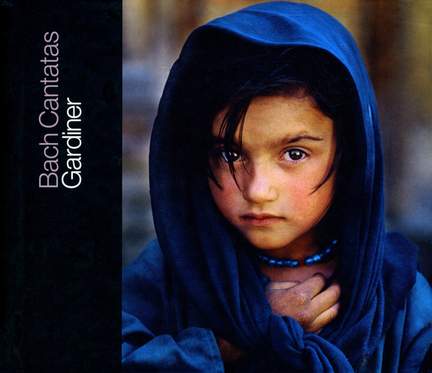
Bach Cantatas Volume 2
Cantatas for the Second Sunday after Trinity & Cantatas for the Third Sunday after Trinity
Lisa Larsson (soprano), Daniel Taylor (countertenor), James Gilchrist (tenor), Stephen Varcoe (bass)
The Monteverdi Choir & The English Baroque Soloists, John Eliot Gardiner
...this vividly scored piece of theatre [BWV21] places both voices and a colourful instrumental group in urgent dialogue. We are drawn into this right from the opening Sinfonia...Among competing...
Bach Cantatas Volume 2
Cantatas for the Second Sunday after Trinity & Cantatas for the Third Sunday after Trinity
Lisa Larsson (soprano), Daniel Taylor (countertenor), James Gilchrist (tenor), Stephen Varcoe (bass)
The Monteverdi Choir & The English Baroque Soloists, John Eliot Gardiner
Purchase product
...this vividly scored piece of theatre [BWV21] places both voices and a colourful instrumental group in urgent dialogue. We are drawn into this right from the opening Sinfonia...Among competing...
About
Recording locations: Recorded live: Paris/Zürich, July 2000
Cantatas for the second and third Sunday after Trinity, recorded live in July 2000.
Performing to an audience of more than 1200, we join Gardiner, The Monteverdi Choir and The English Baroque Soloists at the halfway point of their Bach Cantata pilgrimage for a concert in one of the great architectural landmarks of Catholic Europe, the Basilisque Saint-Denis (Basilica Cathedral of Saint Denis).
Featuring internationally acclaimed soloists including James Gilchrist, Lisa Larsson, Daniel Taylor and Stephen Varcoe, the programme opens with BWV 2 Ach Gott, vom Himmel sieh darein (Oh God, look down from Heaven), based upon Martin Luther’s German hymn adaptation of Psalm 12. The psalm describes how easily man is led astray by heresy and Bach deals with such grim subject matter by resorting to composing in an archaic motet style. The result is austere beauty and has the engrossing quality of ritualised worship. There then follows BWV 10
Schütz’s superb motet Die Himmel erzählen die Ehre Gottes (The heavens are telling of God in glory) follows. This is a motet that John Eliot remembers fondly, since it is a work he has known since he was six and he can still hear his father’s ringing tenor declaiming its powerful text. The concert ends with Bach’s prodigious cantata, BWV 76 Die Himmel erzählen die Ehre Gottes, a lengthy and complex bipartite cantata, comprising fourteen movements and divided into two equal parts.
We then head to Zürich to hear Gardiner and his Monteverdi forces perform within the stunning Fraumünster Kirche, distinctive for its slender, blue spire. They open with the two-part Weimar Cantata BWV 21 Ich hatte viel Bekümmernis (I had much affliction), considered to be ‘…one of the most extraordinary and inspired of Bach’s vocal works’, as stated by John Eliot Gardiner in his booklet note. There then follows BWV 135 Ach Herr, mich armen Sünder (O, Lord, I poor sinner). This is superb music and Bach concludes with a rousing ‘Glory to God’, to the Passion chorale by Cyriakus Schneegaß (1597).
With only two cantatas for this Sunday in existence, the concert ends with Bach’s so-called Triple Concerto, BWV 1044 (Concerto for flute, violin and harpsichord). Despite its similarity to Brandenburg Concerto No.5, it seems to inhabit a different stylistic milieu to that of Bach’s other concerti – one much close to that of his eldest sons.
“This ongoing recording project ranks as one of the musical events of the decade.” The Observer
Contents and tracklist
- Vernon Kirk (tenor), Katherine Fuge (soprano), Robin Tyson (alto), Jonathan Brown (bass)
- Monteverdi Choir, English Baroque Soloists
- Sir John Eliot Gardiner
- Vernon Kirk (tenor), Robin Tyson (alto), Jonathan Brown (bass)
- Monteverdi Choir, English Baroque Soloists
- Sir John Eliot Gardiner
- Maya Homburger (violin), Rachel Beckett (flute), Malcolm Proud (harpsichord)
- English Baroque Soloists
- Sir John Eliot Gardiner
Awards and reviews
 June 2010
...this vividly scored piece of theatre [BWV21] places both voices and a colourful instrumental group in urgent dialogue. We are drawn into this right from the opening Sinfonia...Among competing versions only Richter approaches Gardiner in his apposite sense of theatre.
 June 2010
...here, again, it the spontaneous and committed response of Sir John Eliot Gardiner's musicians which dominates the majority of performances...Gardiner is the king of dramatic moment...As so often in the Pilgrimage, James Gilchrist stands out