Beethoven - Piano Sonatas
Maria Yudina (piano)
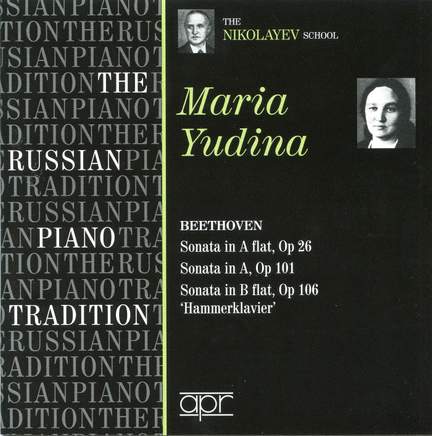
Yudina's expressively confident Beethoven is stimulating, meriting extensive appreciation.
Beethoven - Piano Sonatas
Maria Yudina (piano)
Purchase product
Yudina's expressively confident Beethoven is stimulating, meriting extensive appreciation.
About
We continue our comprehensive survey of the many great pianists who worked in Russia in the Soviet era with the first disc featuring a pianist who was not a pupil of one of the three major teaching traditions we have been following. In this case Maria Yudina’s most influential professor was Leonid Nikolayev (1878 - 1942), who also taught Sofronirsky.
Maria Yudina is perhaps the greatest maverick amongst the Soviet pianists. A woman of great will, and one with a burning Christian faith, she somehow seemed to survive on the fringes of the Soviet system while having countless run-ins with authority. She was never allowed to play outside the USSR and was dismissed successively from the Leningrad and then Moscow conservatories, yet she was much loved by the people and respected by her peers, Shostakovich in particular. She was a great champion of contemporary western music, another thorn in the side of the authorities, and introduced many such works to Soviet audiences, but she was also renowned for her playing of Bach and Beethoven. She made many recordings, which are at last making their way onto CD, but one of the finest is undoubtedly her towering rendition of Beethoven's great masterpiece, the 'Hammerklavier' sonata which is included here.
Contents and tracklist
- Maria Yudina (piano)
- Recorded: 1958
- Recording Venue: Moscow, Russia
- Maria Yudina (piano)
- Recorded: 1958
- Recording Venue: Moscow, Russia
- Maria Yudina (piano)
- Recorded: 1954
- Recording Venue: Moscow, Russia
Awards and reviews
 June 2010
Yudina's expressively confident Beethoven is stimulating, meriting extensive appreciation.
 July 2010
..she is personable and dignified in the Funeral March from Op. 26 and clearly in her element in the brief but intense Adagio from Op. 101. A curious, sometimes fascinating disc
 28th January 2014
What one finds in these three performances are cumulative power and spirit and some very personalised ways with rubati, tempo, timbre and dynamic gradients. That applies to the Op.26 sonata as much as to the two bigger works.