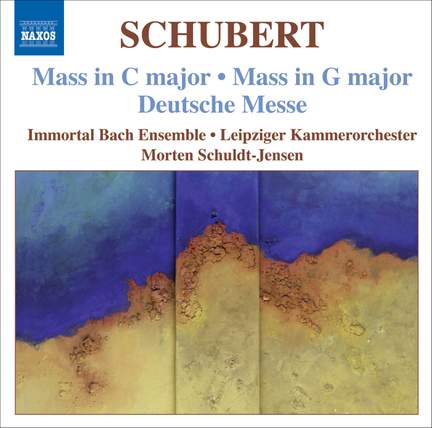
Schubert - Masses in C and G major
Immortal Bach Ensemble & Leipziger Kammerorchester, Morten Schuldt-Jensen
…Schuldt-Jensen's buoyant tempi and the freshness of the choral response do much to vindicate the rococo auto-bustle of parts of the C major Mass. The second soloists… all have light "early...
Schubert - Masses in C and G major
Immortal Bach Ensemble & Leipziger Kammerorchester, Morten Schuldt-Jensen
Purchase product
…Schuldt-Jensen's buoyant tempi and the freshness of the choral response do much to vindicate the rococo auto-bustle of parts of the C major Mass. The second soloists… all have light "early...
About
A chorister from the age of eight until his voice broke seven years later, Franz Schubert was well placed to compose sacred music, including several splendid settings of the Mass.
His second, completed in 1815, and fourth, written during the following year, follow Mozart’s examples but with strikingly Schubertian touches such as his dramatic use of key relationships and contrasting vocal textures to express the prayerful, meditative and glorious nature of the liturgical text.
For the so-called German Mass, Schubert wrote unassuming yet heartfelt settings of congregational hymns for performance during the service.
Contents and tracklist
- Christine Wehler (alto), Tobias Berndt (bass), Claudia Reinhard (soprano), Raimund Minarschik (tenor)
- Leipzig Chamber Orchestra, Immortal Bach Ensemble
- Morten Schuldt-Jensen
- Recorded: 10-12 September 2007
- Recording Venue: Paul-Gerhardtkirche, Leipzig, Germany
- Markus Flaig (bass), Rudiger Ballhorn (tenor), Claudia Reinhard (soprano)
- Leipzig Chamber Orchestra, Immortal Bach Ensemble
- Morten Schuldt-Jensen
- Recorded: 10-12 September 2007
- Recording Venue: Paul-Gerhardtkirche, Leipzig, Germany
- Leipzig Chamber Orchestra, Immortal Bach Ensemble
- Morten Schuldt-Jensen
- Recorded: 10-12 September 2007
- Recording Venue: Paul-Gerhardtkirche, Leipzig, Germany
Awards and reviews
 February 2010
…Schuldt-Jensen's buoyant tempi and the freshness of the choral response do much to vindicate the rococo auto-bustle of parts of the C major Mass. The second soloists… all have light "early music" voices. If the bass sounds strained in the high-lying "Benedictus" of D167, the singers blend well in ensemble, not least in the poignant "Et incarnatus" of the C major Mass.