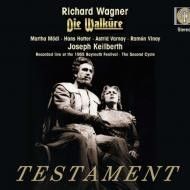
Wagner - Die Walküre
Recorded Festspielhaus Bayreuth 1955
Martha Mödl (Brünnhilde), Hans Hotter (Wotan), Astrid Varnay (Sieglinde), Ramón Vinay (Siegmund), Georgine von Milinkovic (Fricka/Grimgerde), Josef Greindl (Hunding), Dietrich Fischer-Dieskau & Wolfgang Windgassen
Chor & Orchester der Bayreuther Festspiele, Joseph Keilberth
Almost no Walküre… is so well cast and conducted. And the early recording conveys the atmosphere of the Festspielhaus with an honesty and power that are overwhelming.
Wagner - Die Walküre
Recorded Festspielhaus Bayreuth 1955
Martha Mödl (Brünnhilde), Hans Hotter (Wotan), Astrid Varnay (Sieglinde), Ramón Vinay (Siegmund), Georgine von Milinkovic (Fricka/Grimgerde), Josef Greindl (Hunding), Dietrich Fischer-Dieskau & Wolfgang Windgassen
Chor & Orchester der Bayreuther Festspiele, Joseph Keilberth
Purchase product
Almost no Walküre… is so well cast and conducted. And the early recording conveys the atmosphere of the Festspielhaus with an honesty and power that are overwhelming.
About
Die Walküre 1955 – the second cycle
In 2006/07 Testament released for the first time ever (on 14 CDs – SBT14 1412) the legendary stereo recordings made by Decca at Bayreuth of the first cycle of the 1955 performances of the Ring, conducted by Joseph Keilberth and staged by the Festival’s co-director, the radical regisseur Wieland Wagner. Partly for recording security, partly out of interest, Decca’s engineers under producer Peter Andry also recorded the second cycle, from which this first-ever release of Die Walküre is drawn, providing a chance to appreciate the depth of New Bayreuth’s casting resources. Martha Mödl took over as Brünnhilde (she and Astrid Varnay regularly alternated in the Festival cycles between 1953 and 1956) and Varnay took over the role of Sieglinde from Gré Brouwenstijn, thus returning to the role with which she had made her first appearance anywhere on a professional stage – at the Metropolitan Opera in 1941.
Tannhäuser – the preserved excerpts
While taping both the Ring cycles and the performances of Der fliegende Holländer conducted that year by Joseph Keilberth (see Testament SBT2 1384), the Decca team also made some experimental recordings of parts of the Tannhäuser performances Keilberth conducted (he shared the opera in 1955 with André Cluytens). As can be heard in these preserved excerpts, the performances began with the early Dresden version of the overture (which includes its own Bacchanale and comes to a full concert close) and is then followed by the revised Paris version of the Bacchanale complete with choral ending – providing the Wieland/Gertrud production team with extended dance opportunities. Despite his personal feelings, Keilberth inspires his orchestra here to a Toscanini-like sensuality in the dance music. The section recorded from Act III catches the young Dietrich Fischer-Dieskau in his second year at the festival and shows the risks that Wolfgang Windgassen was prepared to take with the role of Tannhäuser – employing, as Wagner himself asked for at the opera’s Paris première in 1861 (and his grandson Wieland similarly demanded in his new Bayreuth stage production), a deliberately hoarse, broken tone for this failed pilgrim’s search for grace. Extract from the booklet note Mike Ashman, 2008
Contents and tracklist
- Martha Mödl (Brünnhilde), Hans Hotter (Wotan), Astrid Varnay (Sieglinde), Ramón Vinay (Siegmund), Georgine von Milinkovic (Fricka/Grimgerde), Josef Greindl (Hunding)
- Bayreuth Festival
- Joseph Keilberth
- Overture, Venusberg Bacchanal (Act I) & Wolfram’s Ballad & Duet (Act III)
- Dietrich Fischer-Dieskau & Wolfgang Windgassen
- Bayreuth Festival
- Joseph Keilberth
Awards and reviews
 Christmas 2009
Almost no Walküre… is so well cast and conducted. And the early recording conveys the atmosphere of the Festspielhaus with an honesty and power that are overwhelming.
 March 2010
The big moments in this performance… offer some vintage Hotter. …in the raging torment of the Act 2 narration and the sorrowful determination of Act 3's Farewell he is supreme.
 9th August 2009
Ramon Vinay, the Siegmund, sounds in healthier voice and sings with greater subtlety [than Siegmund in Decca's first recording of the Ring], while his Sieglinde is Astrid Varnay, the Brünnhilde of the first cycle. She’s not vulnerable — she could have eaten 10 Hundings for breakfast — but she sings gloriously. As well as Hans Hotter’s nonpareil Wotan, there is Martha Mödl’s supremely womanly, sometimes fallible but deeply moving Brünnhilde and Keilberth’s momentous conducting.
 21st August 2009
the dramatic sweep of [Varnay's] singing is thrilling and her scene in the third act with Mödl's Brünnhilde, two of the greatest Wagnerian sopranos of their time toe to toe, is totally compelling.