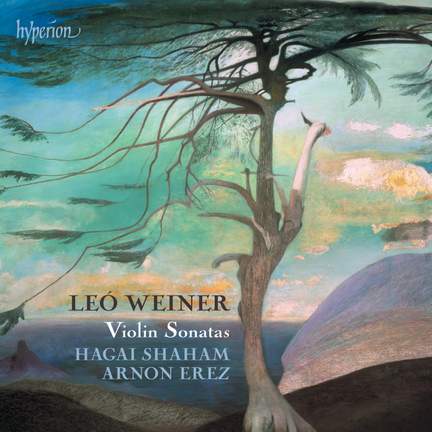
Leó Weiner - Violin Sonatas
Hagai Shaham (violin) & Arnon Erez (piano)
Taken on his own terms Weiner is a composer of much personality and spirit. There's a self-confidence to both his sonatas that is very appealing and he certainly demands much of both players...as...
Leó Weiner - Violin Sonatas
Hagai Shaham (violin) & Arnon Erez (piano)
Purchase product
Taken on his own terms Weiner is a composer of much personality and spirit. There's a self-confidence to both his sonatas that is very appealing and he certainly demands much of both players...as...
About
Hagai Shaham has made himself the master of the Hungarian idiom which prevailed in much Romantic violin music. He now turns to a composer who was one of the leading figures of new Hungarian music in the first few years of the twentieth century, although largely forgotten now. Leó Weiner was regularly hailed as the great new hope of Hungarian music—in 1908 one critic prophesied that he was the Hungarian symphonist that everyone had been waiting for. But in fact he did not produce any symphonies, and it was in chamber music that he fully achieved his early promise.
Hagai Shaham and Arnon Erez present a selection of Weiner’s music for violin and piano—and it is easy to fathom from them why Weiner was such a much-loved figure. His music is fastidious, highly melodic and occasionally nostalgic in appeal—delightfully lyrical and sensitive. It has a highly developed sense of rhythm, especially dance rhythm, and is also highly accomplished technically, of quite admirable craftsmanship. His two important Sonatas for violin and piano are recorded here, and both demonstrate the German romanticism which penetrated his musical vocabulary. The remainder of this disc is centred on Weiner’s works based upon different kinds of Hungarian folk tunes.
Contents and tracklist
- Hagai Shaham (violin), Arnon Erez (piano)
- Hagai Shaham (violin), Arnon Erez (piano)
- Hagai Shaham (violin), Arnon Erez (piano)
- Hagai Shaham (violin), Arnon Erez (piano)
- Hagai Shaham (violin), Arnon Erez (piano)
- Hagai Shaham (violin), Arnon Erez (piano)
Awards and reviews
 May 2010
Taken on his own terms Weiner is a composer of much personality and spirit. There's a self-confidence to both his sonatas that is very appealing and he certainly demands much of both players...as an snapshot of Weiner's diverse talents, it's an absorbing listen.

Highly enjoyable … full of charm and wit … The playing is exemplary … Shaham and Erez make the best possible case for these pieces, duly wearing hearts on sleeve where appropriate
 17th July 2009
Erez's percussive playing emphasises the sparse, pointillistic quality of the piano writing - the product, one suspects, of Weiner being a self-taught pianist. Some of his folk dances are included as a bonus. They're closer in style and spirit to Liszt's Gypsy-inspired Rhapsodies than Bartók's stark folk song arrangements, and done with great elegance and flamboyant ease.