Bruckner - Symphony No. 5
Philharmonia Orchestra, Benjamin Zander
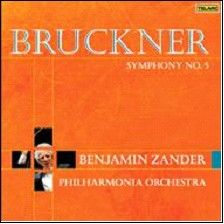
Zander's Fifth must be one of the quickest on record, but it never sounds hurried. This is particularly striking in the slow movement, where Zander takes the first group at such a mobile, flowing...
Bruckner - Symphony No. 5
Philharmonia Orchestra, Benjamin Zander
Purchase product
Zander's Fifth must be one of the quickest on record, but it never sounds hurried. This is particularly striking in the slow movement, where Zander takes the first group at such a mobile, flowing...
About
Benjamin Zander is best known for his outstanding series of recording of Mahler’s symphonies for Telarc. Fanfare called Zander’s interpretation of Mahler’s Fifth Symphony “ a revelation… like Mahler himself, his time has come,” and The Sunday Times called his reading of Mahler’s First and Song of a Wayfarer “…simply magnificent…” Now he is back with the Philharmonia orchestra for a stunning recording of Bruckner’s powerful Symphony No. 5.
Zander had originally planned to record Shostakovich’s Fifth Symphony, but after performing Bruckner’s Fifth with the Boston Philharmonic last season, he realized that this would be his next recording. “It is a masterpiece of staggering proportions,” he says of Bruckner’s Fifth, “one of the greatest symphonies ever written. I had a sudden strong urge to record it.”
Anton Bruckner has been called the “Wagner of the Symphony.” His early works were mostly service music, plainly intended to praise God. When he turned to orchestral music later in life, the intent and philosophy of his sacred compositions were transferred into the newly adopted genre. Benjamin Zander strives in this performance to emphasize the song-like quality of the symphony. “I avoided the very slow tempi that have become common in contemporary interpretations and emphasized the sprightly, forward moving, urgency of the music.”
Recording this momentous symphony “has been a profound and life changing experience,” says Zander. “Especially, it was a revelation to record it with the Philharmonia, only one member of which had performed the work with the orchestra before. She remembered the performance with Klemperer, in which she said the violins got lost for a whole page! The orchestra found the piece absolutely astonishing and riveting. It was a joy to introduce the work to them.”
As with previous releases, the second disc in this 2CD package features Benjamin Zander discussing the music of the symphony. The title is also being made available in the SACD format.
Contents and tracklist
Awards and reviews
 June 2009
Zander's Fifth must be one of the quickest on record, but it never sounds hurried. This is particularly striking in the slow movement, where Zander takes the first group at such a mobile, flowing tempo that the four-against-six cross-rhythms emerge with unusual clarity... The contrast between the two tempos is the Scherzo is also nicely judged, so that the stop-start effect of too many performances is neatly dodged. After this comes a lively and exciting finale, with rhythms again bracingly focused.
 2010
2010
Yet another Bruckner Fifth? Not exactly. The performance, which has its own distinction, comes with an 80-minute bonus disc of unusual quality and interest. Not since the halcyon days of Antony Hopkins 'Talking About Music' has there been a commentary as lucid, as approachable and yet as musically satisfying as this.
Devised by Zander and his co-producer David St George, it is a multifaceted essay. Mapping the symphony has pride of place and is superbly done. It also thrives on a rich array of music examples tucked with consummate skill in, around and beneath the narrative.
Another distinctive touch is his breathing new life into the old cathedral analogy. The CD comes with a foldaway leaflet. On one side is a cathedral floor-plan, on the other the structure of the Fifth Symphony laid over that same plan.
Nor does Zander stop there. His profound and often moving remarks on time, space, spiritual struggle and spiritual renewal grow naturally out of this.
His trump card is his father Walter Zander, who died in 1993 at the age of 95. In the summer of 1918, while fighting on the Russian front, Walter was sent a score of Bruckner's Fifth Symphony by his mother. His letters home with their comments on what the music meant to him have only recently reappeared. These, too, have been woven into the narrative, and very remarkable they are.
Despite his father's urging, Zander did not study the symphony until he was past 60. Antony Hopkins once said that some of his best scripts were written on works he knew little about before writing. Zander seems to have been similarly blessed, creating a remarkable narrative and complementing it with a performance of great lucidity and drive. If the finely geared playing seems a touch lightweight in places, turning up the level of the beautifully judged Watford Coliseum recording helps bulk out the vertical dimension.
 May 2009
Yet another Bruckner Fifth? Not exactly. The performance, which has its own distinction, comes with an 80-minute bonus disc of unusual quality and interest. Not since the halcyon days of Antony Hopkins "Talking About Music" have I heard a commentary as lucid, as approachable and yet as musically satisfying as this.