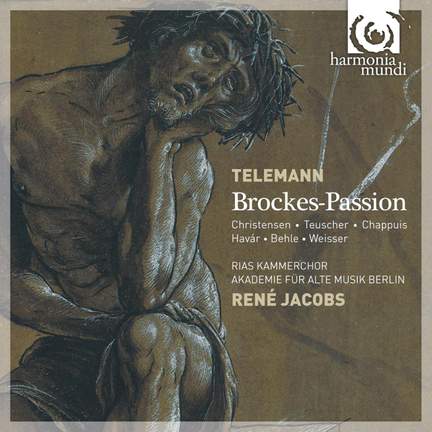
Telemann: Passion Oratorio 'Mich vom Stricke meiner Sünden' ('Brockes Passion'), TWV 5:1
Birgitte Christensen, soprano (Tochter Zion I, Gläubige Seele I, Maria, 3. Magd), Lydia Teuscher, soprano (Tochter Zion II, Gläubige Seele II, 2. Magd), Marie-Claude Chappuis, mezzosoprano (Judas, Gläubige Seele III, 1. Magd), Donát Havár, tenor (Petrus, Pilatus, Gläubige Seele IV, Hauptmann), Daniel...
Awards:
-
Presto Recording of the Week, 19th October 2009

-
BBC Music Magazine Awards, 2010, Choral Finalist

…Jacobs…has mustered, with characteristic discernment, a highly responsive cast of soloists. Daniel Behle is a communicative Evangelist, responding alertly to Telemann's elegantly shaped recitative…...
Telemann: Passion Oratorio 'Mich vom Stricke meiner Sünden' ('Brockes Passion'), TWV 5:1
Birgitte Christensen, soprano (Tochter Zion I, Gläubige Seele I, Maria, 3. Magd), Lydia Teuscher, soprano (Tochter Zion II, Gläubige Seele II, 2. Magd), Marie-Claude Chappuis, mezzosoprano (Judas, Gläubige Seele III, 1. Magd), Donát Havár, tenor (Petrus, Pilatus, Gläubige Seele IV, Hauptmann), Daniel...
Purchase product
Awards:
-
Presto Recording of the Week, 19th October 2009
-
BBC Music Magazine Awards, 2010, Choral Finalist
…Jacobs…has mustered, with characteristic discernment, a highly responsive cast of soloists. Daniel Behle is a communicative Evangelist, responding alertly to Telemann's elegantly shaped recitative…...
About
"The poet Barthold Heinrich Brockes was a Hamburg contemporary of Bach and Telemann. His Passion oratorio text is not the liturgical kind but largely consists of poetic images and sentiments which reflect changing taste and the newer values of the German Enlightenment. It was an immediate success and was set to music first by Keiser, then by Handel and Telemann in 1716 and subsequently by Mattheson, Fasch and Stölzel. Bach, too, used portions of it in his St John Passion. René Jacobs has more than once proved himself an eloquent advocate for Telemann's vocal music, notably with his fine recording of his opera, Orpheus (harmonia mundi). Now, 18 years after Nicholas McGegan's long deleted version of the Brockes Passion (Hungaroton), comes another chance to become acquainted with this richly rewarding score whose text, with its highly charged emotional language, combines to create some startlingly vivid imagery. It was praised to the skies after the first performance in Frankfurt and, thereafter Telemann himself noted 'this Passion caused choir stalls and chancels in many German towns to be filled with sound'. This is a splendid recording for which Jacobs has mustered, with characteristic discernment, an effective cast of soloists. Daniel Behle is a communicative Evangelist - a far stronger performance than Martin Klietmann in the older version - and Johannes Weisser a resonant, warm-textured Jesus.The remaining cast, freshvoiced, lightly articulated and agile affords uninterrupted pleasure, and that goes for the excellent RIAS Chamber Choir, too. In short all concerned seem to have embraced the evocative if, at times, sentimental ethos of the work. Right from the start Telemann draws us into the piece with a poignant C minor Sinfonia with its passages of dissonant harmony and virtuoso oboe writing. " Nicholas Anderson, BBC Music Magazine April 2009
Artists
Birgitte Christensen, soprano (Tochter Zion I, Gläubige Seele I, Maria, 3. Magd), Lydia Teuscher, soprano (Tochter Zion II, Gläubige Seele II, 2. Magd), Marie-Claude Chappuis, mezzosoprano (Judas, Gläubige Seele III, 1. Magd), Donát Havár, tenor (Petrus, Pilatus, Gläubige Seele IV, Hauptmann), Daniel Behle, tenor (Evangelist, Gläubige Seele VI) & Johannes Weisser, baritone (Jesus, Gläubige Seele V)
RIAS Kammerchor & Akademie für Alte Musik Berlin, René Jacobs
Contents and tracklist
Spotlight on this release
-
An error occurred.
Try watching this video on www.youtube.com, or enable JavaScript if it is disabled in your browser.
-
Idomeneo from René Jacobs
18th May 2009
Following his landmark accounts of the three Da Ponte opera, Jacobs tackles Mozart’s early opera seria, with Richard Croft as the Cretan king, Bernarda Fink as his estranged son, and Alexandrina Pendatchanska spitting fire as Elettra.

Awards and reviews
-
Presto Recording of the Week19th October 2009
 April 2009
…Jacobs…has mustered, with characteristic discernment, a highly responsive cast of soloists. Daniel Behle is a communicative Evangelist, responding alertly to Telemann's elegantly shaped recitative… As Jesus, Johannes Weisser brings warmth and appropriate gravitas. The remaining cast, fresh-voiced, lightly articulated and agile, gives uninterrupted pleasure, and that goes for the excellent RIAS Chamber Choir too.
 2010
2010
The Hamburg poet Barthold Heinrich Brockes wrote the Passion oratorio libretto Der für dieSünde der Welt gemarterte und sterbende Jesus for Reinhard Keiser to set to music in 1712. Handel composed a setting in London about four years later (probably for Hamburg), and in April 1716 Telemann's version was first performed in Frankfurt. The broody opening Sinfonia makes one think of Haydn's late orchestral writing at its most daring. The Berlin AAM's playing is lean and angular but the 35-strong RIAS Chamber Choir seems overpowering at times, and it would be good to hear this work performed by smaller and more integrated forces.
René Jacobs divides the soprano arias for the Daughter of Zion and the Faithful Soul between Birgitte Christensen and Lydia Teuscher (the booklet fails to indicate what singer performs which arias): 'Was Bärentatzen, Löwenklauen' has snappy percussive horn fanfares, and several contrasting arias during the scene of Christ's scourging are among the highest points of the oratorio. Marie-Claude Chappuis's singing of Judas's guilt-wracked scene, in which the betrayer resolves to commit suicide, is extraordinary. The trio 'O Donnerwort!' crackles with theatrical velocity.
Johannes Weisser is a grainy Jesus, but his declamatory singing in the volatile 'Erwäg, ergrimmte Natterbrut' is impressive. Donát Havár does not have a mellifluous timbre but is a good communicator of Peter's texts. Jacobs paces the oratorio as if it is a vivid religious opera: he omits six arias and two recitatives 'for reasons of dramatic coherence'. There are moments of brittle intensity that could have afforded more gentleness, but Jacobs's committed vision provides us with a valuable glimpse of Telemann's brilliant imagination.
 August 2009
Jacobs paces the oratorio as if it is a vivid religious opera… There are moments of brittle intensity that could have afforded more gentleness, but Jacobs's committed vision provides us with a valuable glimpse of Telemann's brilliant imagination.
 29th March 2009
A string of beautifully varied arias are leavened by chorals, and there is an astonishing trio for Three Believing Souls, describing the earthquake after the death of Christ. This is the avant-garde music of the period by an ever-inquiring, always rewarding composer.
 3rd April 2009
Like Jacobs's earlier Harmonia Mundi recording of the opera Orpheus, it's a significant addition to the Telemann discography.
 4th May 2009
Telemann's musical setting highlights the drama with brilliant orchestral touches. Throughout, the orchestral playing is amazingly vivid and Birgitte Christensen as Mary is thrilling.
 3rd April 2009
This is oratorio as opera: immediate, openly emotional, brilliantly characterised.