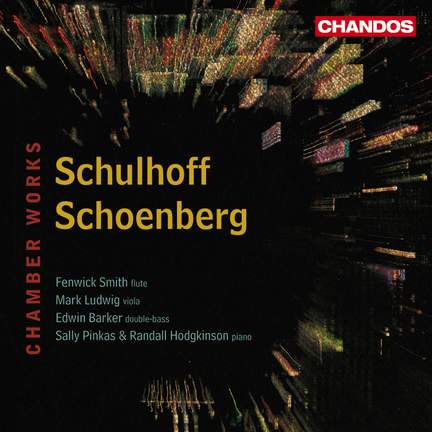
Schulhoff & Schoenberg - Chamber Works
Fenwick Smith (flute) & Randall Hodkinson (piano)
…the performances of both Schulhoff scores are excellent, even if the piano tone verges on harsh in places. There's genuine historical interest in this transformation of Schoenberg's Quintet...
Schulhoff & Schoenberg - Chamber Works
Fenwick Smith (flute) & Randall Hodkinson (piano)
Purchase product
…the performances of both Schulhoff scores are excellent, even if the piano tone verges on harsh in places. There's genuine historical interest in this transformation of Schoenberg's Quintet...
About
The flautist Fenwick Smith whose adventuresome discography includes premiere recordings of works by Copland, Ginastera, Koechlin, Schoenberg, Gaubert, Harbison, Cage and Reinecke retired from the Boston Symphony Orchestra in 2006 after twenty-eight distinguished years with that institution. With his Boston Symphony Orchestra career behind him, Smith has taken on an expanded teaching commitment at the Conservatory.
The repertoire in this recording features two innovative Jewish composers – Erwin Schulhoff and Arnold Schoenberg - who pursued widely differing musical styles – and who met very different fates. The three pieces performed here were completed by August 1924 and March 1927. They are not particularly Jewish in style, but are rather more reflective of the era in which they were written.
Schulhoff was born in Prague to a wealthy Jewish family. A prodigy, he began piano studies at the Prague Conservatory at the urging of Dvorak. In 1923 he settled in Germany, where he was receptive to the musical influences then current – principally jazz, neoclassicism and Dadaism. By the late 1930s, Schulhoff had returned to Prague, which was an increasingly perilous city for Jews. He was deported to the Wulzburg concentration camp in the winter of 1941, where he died of tuberculosis. Smith and Hodkinson here perform Schulhoff’s Flue Sonata and Concertino. The instrumentation of the Concertino is unique: flute doubling piccolo, viola, and contrabass, and the result is a fine rustic work, described by Schulhoff as: “Moravian seller of shepherds’ flutes in the streets of Prague.”
These two rarely performed works are coupled with the rarely recorded transcription of Schoenberg’s Sonata for Wind Quintet, Op.26 by Felix Greissle. The Quintet was Schoenberg’s first strict twelve-tone composition. Fenwick Smith corresponded with Greissle when preparing the Sonata for performance and recording.
Fenwick Smith is here accompanied by Randall Hodkinson. Both artists make their debut with Chandos with this recording.
Contents and tracklist
- Fenwick Smith, Sally Pinkas, Mark Ludwig, Edwin Barker
- Fenwick Smith, Mark Ludwig, Edwin Barker
- Fenwick Smith, Randall Hodgkinson
Awards and reviews
 July 2009
…the performances of both Schulhoff scores are excellent, even if the piano tone verges on harsh in places. There's genuine historical interest in this transformation of Schoenberg's Quintet into a Flute Sonata… this is a well characterised performance, true to the remarkable expressive range of the work while not making a conclusive case for its use as a regular alternative to the original.
 3rd
3rd May 2009
3rd
3rd May 2009
Schoenberg’s Sonata (pianist Randall Hodgkinson) — an arrangement made under his supervision by Felix Greissle — is much more evidently touched by the 20th century and its dark rigours, though the dominant quality is of a kind of demented neoclassical bustle. It comes off magnificently.