Szymanowski - Symphonies Nos. 1 & 4
Ewa Marczyk (violin solo) & Marek Marczyk (viola solo), Marek Marczyk (viola solo), Jan Krzysztof Broja (piano) & Ewa Marczyk (violin solo)
Warsaw Philharmonic Orchestra, Antoni Wit
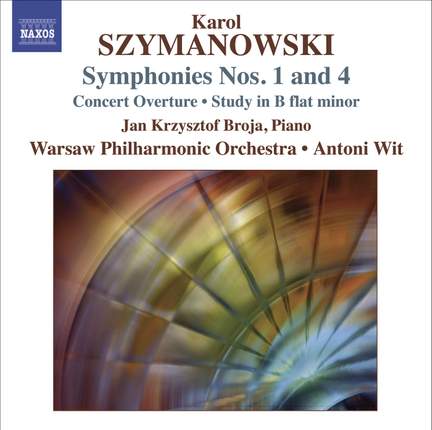
…the Symphony No. 4… receives the slowest recorded performance I know… At the opening, with timpani tolling away underneath, the piano traces a languorously decorative line. In the middle...
Szymanowski - Symphonies Nos. 1 & 4
Ewa Marczyk (violin solo) & Marek Marczyk (viola solo), Marek Marczyk (viola solo), Jan Krzysztof Broja (piano) & Ewa Marczyk (violin solo)
Warsaw Philharmonic Orchestra, Antoni Wit
Purchase product
…the Symphony No. 4… receives the slowest recorded performance I know… At the opening, with timpani tolling away underneath, the piano traces a languorously decorative line. In the middle...
About
Although Szymanowski later dubbed his First Symphony a “contrapuntal-harmonic-orchestral monster” and disavowed the influence of Wagner, Reger and Richard Strauss (also evident in the opulent Concert Overture), it is an astonishingly powerful work by a composer only in his mid-20s and still enthralls a century after its première.
He described his Fourth Symphony as “nearly a concerto” owing to the piano’s prominent rôle, its highly-charged Neo-baroque character inviting comparison with Stravinsky.
The Naxos recordings of 8570724, Szymanowski’s Stabat Mater, is nominated in the Choral catagory of the BBC Music Awards 2009.
Contents and tracklist
- Warsaw Philharmonic Orchestra
- Antoni Wit
- Recorded: 1, 2, 4 August 2006
- Recording Venue: Warsaw Philharmonic Concert Hall, Warsaw, Poland
- Warsaw Philharmonic Orchestra
- Antoni Wit
- Recorded: 2-3 January 2008
- Recording Venue: Warsaw Philharmonic Concert Hall, Warsaw, Poland
- Jan Krzysztof Broja (piano)
- Warsaw Philharmonic Orchestra
- Antoni Wit
- Recorded: 4-5 September 2007
- Recording Venue: Warsaw Philharmonic Concert Hall, Warsaw, Poland
- Warsaw Philharmonic Orchestra
- Antoni Wit
- Recorded: 6 September 2007
- Recording Venue: Warsaw Philharmonic Concert Hall, Warsaw, Poland
Awards and reviews
 July 2009
…the Symphony No. 4… receives the slowest recorded performance I know… At the opening, with timpani tolling away underneath, the piano traces a languorously decorative line. In the middle movement, the flute solo sounds especially dreamy, and the finale, inspired by folk music from the Tatra mountains, takes on raw vigour while allowing the pianist Jan Krzysztof Broja to show his virtuosity.
 2010
2010
The early Concert Overture, son of Rosenkavalier and proud of it, is resplendently played here, only at rare moments craving a more glamorous sound stage. And the over-heated two-movement First Symphony, which the composer himself described as a 'contrapuntal-harmonic-orchestral monstrosity' and withdrew after its premiere, emerges as far more purposeful and less rebarbative than any of the admittedly few rival versions that have come and gone over the years.
As a listening experience the Fourth Symphony is initially somewhat more problematic, in that the opening pages (surely the model for Bartók's Third Piano Concerto) suffer from slight intonation problems between the concertante piano and the orchestra. But with a bit of acclimatisation, helped by the firm and affectionate shaping of the performance, this proves to be liveable with. Jan Krzysztof Broda seems to grow in stature through the rhapsodic slow movement, and he never loses the thread in the finale's Ravelian and Prokofievian deviations.
All in all, it would take significantly greater financial outlay to find anything better than this, and even then the differences would be marginal.
 August 2009
… passionate playing and exceptional musical understanding of the Warsaw Philharmonic under their general and artistic director. The early Concert Overture, son of Rosenkavalier and proud of it, is resplendently played here…