Special offer. Feldman, M: For Christian Wolff
Dorothy Stone (flute) & Vicki Ray (piano, celesta)
California EAR Unit
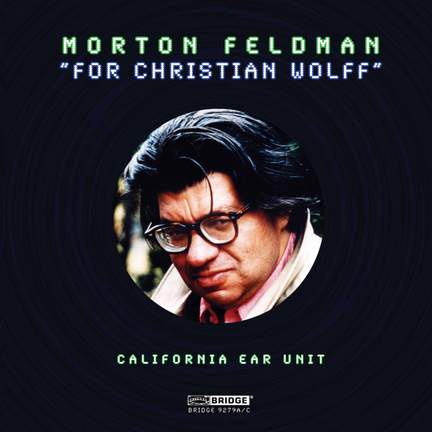
First performed in 1986, a little over a year before his death, Morton Feldman's For Christian Wolff belongs with the other vast, obsessive scores of his final years, such as For Philip Guston...
Special offer. Feldman, M: For Christian Wolff
Dorothy Stone (flute) & Vicki Ray (piano, celesta)
California EAR Unit
Purchase product
First performed in 1986, a little over a year before his death, Morton Feldman's For Christian Wolff belongs with the other vast, obsessive scores of his final years, such as For Philip Guston...
About
For Christian Wolff is one of Morton Feldman's final compositions, and is over four hours long. Writing about hearing this work, Christian Wolff says that “I found the experience of listening to it beautiful and interesting – it moves away partly from our original preoccupation with just sound and sonority into areas of self-awareness about listening, being a listener…”.
Contents and tracklist
Feldman, M:
For Christian Wolff, Pt. 1
Work length1:00:14
This work is only available as an album download.
- Dorothy Stone, Vicki Ray
- California EAR Unit
Feldman, M:
For Christian Wolff, Pt. 2
Work length55:38
This work is only available as an album download.
- Dorothy Stone, Vicki Ray
- California EAR Unit
Feldman, M:
For Christian Wolff, Pt. 3
Work length1:01:22
This work is only available as an album download.
- Dorothy Stone, Vicki Ray
- California EAR Unit
Awards and reviews
 6th February 2009
First performed in 1986, a little over a year before his death, Morton Feldman's For Christian Wolff belongs with the other vast, obsessive scores of his final years, such as For Philip Guston and the Second String Quartet. This is a single movement for flute and keyboard (piano doubling celesta), lasting almost three hours. The sleeve notes characterise For Christian Wolff as a "garrulous masterwork". But garrulous seems a strange adjective to apply to a piece, written for one of Feldman's oldest friends and a close collaborator in the 1950s, that ekes out its thematic material with parsimonious rigour, reducing it to the barest minimum of pitches and intervals, often to just a rising or falling semitone or tone.
In such a vastly expanded musical landscape the smallest shift or inflection assumes huge significance, while the tonal variety Feldman wrings from this limited palette is extraordinary. That places enormous demands on the concentration of the players, and the flautist Dorothy Stone and keyboard player Vicki Ray maintain that unstintingly. They are let down by the recording, though, which places instruments in a rather crude, close perspective, so there is too little space around these pared-down sounds.