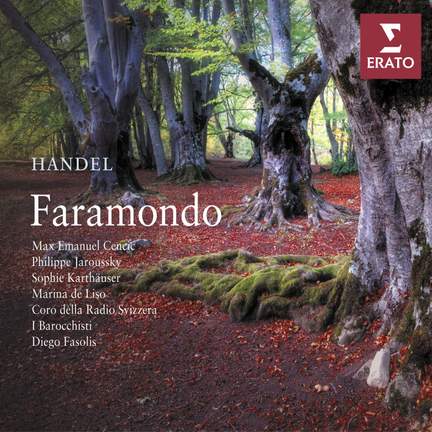
Special offer. Handel: Faramondo
Max Emanuel Cencic (Faramondo), Philippe Jaroussky (Adolfo), Sophie Karthäuser (Clotilde), Marina de Liso (Rosimonda), Xavier Sabata (Gernando), Terry Wey (Childerico), In-Sung Sin (Gustavo), Fulvio Bettini (Teobaldo)
Choeur de la Radio Suisse, Lugano & I Barocchisti, Diego Fasolis
Awards:
-
Gramophone Magazine, July 2009, Editor's Choice

…overall a decent account is given of this worthwhile rarity.
Special offer. Handel: Faramondo
Max Emanuel Cencic (Faramondo), Philippe Jaroussky (Adolfo), Sophie Karthäuser (Clotilde), Marina de Liso (Rosimonda), Xavier Sabata (Gernando), Terry Wey (Childerico), In-Sung Sin (Gustavo), Fulvio Bettini (Teobaldo)
Choeur de la Radio Suisse, Lugano & I Barocchisti, Diego Fasolis
Purchase product
Awards:
-
Gramophone Magazine, July 2009, Editor's Choice
…overall a decent account is given of this worthwhile rarity.
About
Handel’s opera Faramondo (Pharamond), still rarely performed, is set in 5th century France. The title role, a mythical king, is taken by Zagreb-born countenor Max Emanuel Cencic, an alumnus of the Vienna Boys’ Choir, who took a starring role in Virgin Classics’ recent DVD of Landi’s Sant’Alessio and in September 2007 released a thrilling recital of virtuoso Rossini arias. On stage he has performed a number of Handel operas: Giulio Cesare, Tamerlano, Fernando and Serse (written shortly after Faramondo). The other star countertenor on this recording is Philippe Jaroussky, whose Virgin Classics album Carestini – The Story of a Castrato included arias by Handel and who was recently named Singer of the Year in Germany’s Echo Klassik awards.
This production of Faramondo is probably unique in recording history – and maybe also in the performing history of Handel’s operas since the 18th century. It finally gives us a complete recording of a Handel opera with men singing all the male characters cast for singers with high voices: Phillippe Jaroussky in the soprano role of Faramondo’s son, Adolfo; Xavier Sabata in the dramatic alto role of the vicious King Gernando, and Max Emanuel Cencic in the mezzo soprano role of Faramondo. At the opera’s first performances in London in 1738, Faramondo was sung by the star castrato Caffarelli, but the other two parts were sung by women dressed as men, since Handel could not afford to pay for additional castrati, who were the highest-paid stars of the day. Since then, women have generally been engaged to sing the highest male roles in Handel operas, with countertenors often being allocated the characters with music in the alto range.
As with female singers, there were alto, mezzo soprano and soprano castrati. Until recently, countertenors have tended to take the lower-lying roles that Handel and other Baroque composers wrote for castrati. Now, a growing number of countertenors also sing in the mezzo and soprano ranges. Cencic, Jaroussky and Sabata are part of this generation of ‘operatic countertenors’ who can provide the vocal agility and range of colour which have perhaps been more readily associated with the female voice.
Beyond the countertenors, there are talented young singers in all the other roles: the Belgian soprano Sophie Karthäuser (already featured in the Virgin Classics catalogue in Haydn’s Creation with William Christie), who has a pure, but vibrant sound; two Italians – powerful mezzo Marina de Liso and expressive bass-baritone Fulvio Bettini; In-Sung Sim from South Korea, a basso profundo who can sing superb coloratura and Swiss-born Terry Wey, another young countertenor (he is just 23) and also a former member of the Vienna Boys’ Choir, who takes the role of Childerico, sung in Handel’s time by a boy treble.
Diego Fasoli, also from Switzerland, conducts his orchestra I Barocchisti. Le Monde, describing their Handel, has written of “ a tonal subtlety and a palette of emotional colour that compel admiration ... While being lively and playful, it is never aggressive or superficial.”
Contents and tracklist
- In-Sung Sim (bass), Philippe Jaroussky (countertenor), Fulvio Bettini (baritone), Sophie Karthäuser (soprano), Marina de Liso (mezzo-soprano), Max Emanuel Cenčić (countertenor), Terry Wey (countertenor), Xavier Sabata (countertenor), Philippe Jaroussky (tenor)
- I Barocchisti, Coro della Radio Svizzera, Lugano
- Diego Fasolis
- Recorded: 2008-10-24
- Recording Venue: 19 -24 October, 2008. Radio della Svizzera Italiana, Auditorio Stelio Molo, Lugano
- Marina de Liso (mezzo-soprano), Terry Wey (countertenor), Xavier Sabata (countertenor), Fulvio Bettini (baritone), Max Emanuel Cenčić (countertenor), Sophie Karthäuser (soprano), In-Sung Sim (bass), Philippe Jaroussky (countertenor), Max Emmanuel Cencic (countertenor)
- I Barocchisti
- Diego Fasolis
- Recorded: 2008-10-24
- Recording Venue: 19 -24 October, 2008. Radio della Svizzera Italiana, Auditorio Stelio Molo, Lugano
- In-Sung Sim (bass), Sophie Karthäuser (soprano), Philippe Jaroussky (countertenor), Fulvio Bettini (bass-baritone), Max Emanuel Cenčić (countertenor), Xavier Sabata (countertenor), Max Emmanuel Cencic (countertenor), Marina De Liso (mezzo-soprano), Terry Wey (vocals)
- I Barocchisti, Coro Della Radio Svizzera
- Diego Fasolis
- Recorded: 2008-10-24
- Recording Venue: 19 -24 October, 2008. Radio della Svizzera Italiana, Auditorio Stelio Molo, Lugano
Awards and reviews
-
Gramophone MagazineJuly 2009Editor's Choice
 May 2009
…overall a decent account is given of this worthwhile rarity.
 2010
2010
Faramondo (1738) was written after the remnants of the Opera of the Nobility and Handel's opera company merged together for one peculiar and unsuccessful season at the King's Theatre. Virgin Classics has made much of the fact that this is the first Handel opera recording in which all the male characters are sung at the correct pitch by male singers, but several of the illustrious countertenors involved occasionally drop a few notes down an octave in order to conserve their larynxes.
I Barocchisti's playing of the fine concertogrosso-style Overture is zesty. Handel's scoring of the chorus 'Pera, pera' doesn't include the drums and trumpets employed here, and a few more euros could have been saved by not using unhistorical organ and guitar in the continuo group. Sophie Karthäuser's light navigation of Clotilde's arias provides some nice moments ('Combattuta da due venti' is eloquent rather than tempestuous, but none the worse for a bit of measured clarity and detail in its oscillating orchestral figures). Philippe Jaroussky and Max Emanuel Cencic each give attractive performances of virtuoso arias. Adolfo's slow aria 'Se a' piedi tuoi morrò' is delightful for its polished orchestral playing and Jaroussky's pleasant singing. Cencic's high-lying tessitura and brilliant coloratura are almost flawless (the tender cavatina 'Sì, tornerò a morir' is beautifully judged by singer, orchestra and conductor; the heroic 'Se ben mi lusinga' is dazzling, but the duet 'Vado e vivo' has a few hints of strain).
Xavier Sabata demonstrates his muskier voice in the enraged 'Voglio che mora, sì', but hams up his da capo too much. Marina de Liso gives a stunning performance of Rosimonda's turbulent 'Sì, l'intendesti, sì' (in which Diego Fasolis brings out exciting details in the accompaniment), and the bass villain Gustavo is resonantly sung by In-Sung Sim. Fasolis's direction is exemplary for its warmly authoritative expressiveness and fluent mastery over detail. Faramondo is revealed as a much better score than previously thought.
 July 2009
Philippe Jaroussky and Max Emanuel Cencic each give attractive performances of virtuoso arias. Marina de Liso gives a stunning performance of Rosimonda's turbulent "Si, l'intendesti, sì" (in which Diego Fasolis brings out exciting details in the accompaniment), and the bass villain Gustavo is resonantly sung by In-Sung Sim. Fasolis's direction is exemplary for its warmly authoritative expressiveness and fluent mastery over detail. Faramondo is revealed as a much better score than I had previously realised.
 2010
2010
a cast of fresh young singers giving stylish performances with no suspicion of aspirated coloratura...[The title-role] is very well taken by Max Emanuel Cencic, coping well with the exceptionally low-lying register
 10th April 2009
A cool, brilliant operatic game, it's devastatingly realised by Diego Fasolis and I Barocchisti in a recording that for many will seem like countertenor heaven. Most people will probably want to hear it for either Max Emanual Cencic in the title role or Philippe Jaroussky's Adolfo. The star turns, however, come from Xavier Sabata's chameleon-like Gernando and from Marina de Liso as firebrand Rosimonda and Sophie Karthäuser as the irritatingly virtuous Clotilde. The whole thing is a revelation.
 18th February 2009
Composed towards the end of Handel's long operatic career, Faramondo has enjoyed few modern revivals – a neglect which the Handel scholar Jonathan Keates ascribes to the weakness of its tortuous libretto and pallid characterisation rather than any musical shortcomings.
This lively and attractive recording certainly reveals an invigorating score, swiftly paced with a wealth of incisive, tuneful arias and a welcome absence of dry recitative.
The cast is notable for the flamboyant contributions of the impressive young countertenors Max Emanuel Cencic (in the title role) and Philippe Jaroussky. Strongly recommend to diehard Handel fans.