Special offer. Handel: Acis and Galatea
Julia Kleiter & Christoph Prégardien
Festival Orchestra Göttingen & North German Radio Choir, Nicholas McGegan
While no-one nowadays would suggest that Handel's score needs such additions, Mendelssohn was a man of considerable taste, who made his changes with the best possible motives. In 'Hush ye pretty...
Special offer. Handel: Acis and Galatea
Julia Kleiter & Christoph Prégardien
Festival Orchestra Göttingen & North German Radio Choir, Nicholas McGegan
Purchase product
While no-one nowadays would suggest that Handel's score needs such additions, Mendelssohn was a man of considerable taste, who made his changes with the best possible motives. In 'Hush ye pretty...
About
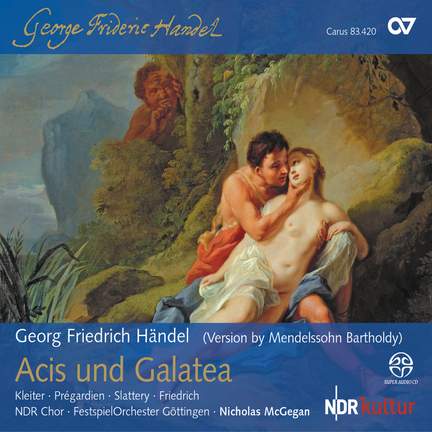
Acis and Galatea was one of the most successful of George Frideric Handel’s works during his lifetime. Nicholas McGegan and his Festspiel Orchester Göttingen, along with the North German Radio Choir, and an excellent ensemble of soloists (including Julia Kleiter and Christoph Prégardien) are heard in this recently discovered version by Mendelssohn.
Contents and tracklist
- FestspielOrchester Göttingen
- Nicholas McGegan
- Recorded: 2008-09-01
- Julia Kleiter (soprano), Christoph Prégardien (tenor), Michael Slattery (tenor)
- FestspielOrchester Göttingen, NDR Chor
- Nicholas McGegan
- Recorded: 2008-09-01
- Wolf Matthias Friedrich (bass), Julia Kleiter (soprano), Michael Slattery (tenor), Christoph Prégardien (tenor)
- FestspielOrchester Göttingen, NDR Chor
- Nicholas McGegan
- Recorded: 2008-09-01
Awards and reviews
 March 2009
While no-one nowadays would suggest that Handel's score needs such additions, Mendelssohn was a man of considerable taste, who made his changes with the best possible motives. In 'Hush ye pretty warbling choir'… Mendelssohn's luminous chords have their own elfin magic to replace Handel's quirkier birdsong. Nicholas McGegan sways a light baton over the whole, and both his players and soloists are good, with a scrupulously well-trained choir in attendance.
 2010
2010
The virtues of Acis and Galatea were clear enough more than a century later for the 19-year-old Mendelssohn to arrange the work for the Berlin Sing-Akademie in 1828-29 (with a German version of the libretto prepared by his sister Fanny). One might uncharitably (but accurately) criticise that the teenage Mendelssohn's feverish excitement at discovering Handel led to him throwing everything he could (almost including the kitchen sink, so it seems) at the music. Unlike Mozart's more discreet and softer reorchestration of Acis (1788), there is an intense amount of intervention in Mendelssohn's orchestral score, which is tailored for a full-scale symphony orchestra and large chorus.
Nicholas McGegan and his Göttingen Festival Orchestra gave the modern premiere of Mendelssohn's score at the 2008 Göttingen Handel Festival, and the ensuing recording is crisply detailed. The most amusing effects are huge bursts of brass and timpani explosions associated with Polyphemus, who is sung with gusto by Wolf Matthias Friedrich. Acis is sung with a hint of strain by Christoph Prégardien, and Julia Kleiter's Galatea is efficient.
The NDR Choir are jovial or doleful as the music requires. McGegan directs with liveliness, and it's hard to imagine this arrangement receiving a better advocate. It's bombastic and clumsy in comparison to Handel's delightful original, but the young Mendelssohn's perspective is entertaining.
 January 2009
The most amusing effects are huge bursts of brass and timpani explosions associated with Polyphemus, who is sung with gusto by Wolfe Matthias Friedrich. McGegan directs with liveliness, and it’s hard to imagine this arrangement receiving a better advocate.
 18th January 2009
The happy coincidence of Handel and Mendelssohn anniversaries – the 250th of Handel’s death, the 200th of Mendelssohn’s birth – make this a timely issue. Julia Kleiter’s enchanting Galatea, Christoph
Prégardien’s virile Acis and Wolf Matthias Friedrich’s slightly po-faced Polyphemus are superb stylists.