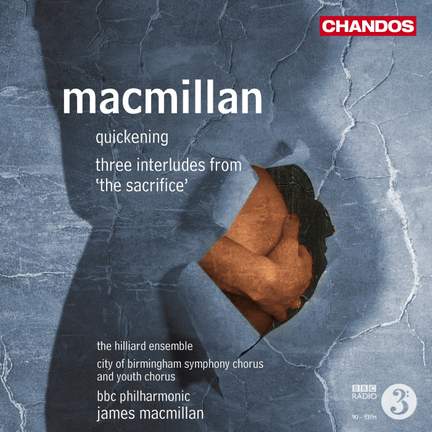
MacMillan - Quickening & The Sacrifice
The Hilliard Ensemble, City of Birmingham Symphony Chorus and Youth Chorus & BBC Philharmonic, James MacMillan
Quickening itself could be described as 'catholic' in many senses: in the music's daringly wide stylistic embrace; in the ritual element that interweaves surprisingly easily with purposeful...
MacMillan - Quickening & The Sacrifice
The Hilliard Ensemble, City of Birmingham Symphony Chorus and Youth Chorus & BBC Philharmonic, James MacMillan
Purchase product
Quickening itself could be described as 'catholic' in many senses: in the music's daringly wide stylistic embrace; in the ritual element that interweaves surprisingly easily with purposeful...
About
As James MacMillan celebrates his 50th birthday he here conducts his large-scale, complex work, The Quickening coupled with the symphonic suite The Sacrifice: Three Interludes, taken from his opera, The Sacrifice, a work based on a medieval Welsh tale and focusing on issues of love and conflict. Co-commissioned by the BBC Proms and the Philadelphia Orchestra, The Quickening sets poetry by MacMillan’s frequent collaborator Michael Symmons Roberts. Hailed as some of the most distinguished writing since that of Benjamin Britten, the powerfully imaginative score explores the themes of birth, new life and new impulses, but as MacMillan says, it also has its dark side out of which hope is glimpsed. Joining the BBC Philharmonic is the Hilliard Ensemble, who premiered the work at the BBC Proms, accompanied by the City of Birmingham Symphony Chorus and Youth Chorus.
MacMillan was awarded the 2008 Royal Philharmonic Society Opera and Music Theatre Award The Sacrifice following its premiere in September 2007 by Welsh National Opera. As did Britten in the now-famous Four Sea Interludes from his opera Peter Grimes, MacMillan uses the Interludes as opportunities to withdraw from and reflect on the action, and he says, ‘the orchestra provides another dimension to the narrative and to the drama, which allows the imagination to travel deeper or in a different direction.’
James MacMillan is one of the UK’s leading contemporary composers, and several of his earlier compositions are available on Chandos under his direction, including The Confessions of Isobel Gowdie (Classic FM Award winner), and The Berserking.
Contents and tracklist
- Sir James MacMillan, BBC Philharmonic
- Sir James MacMillan, BBC Philharmonic, The Hilliard Ensemble, City of Birmingham Symphony Youth Chorus, City of Birmingham Symphony Chorus
Awards and reviews
 March 2009
Quickening itself could be described as 'catholic' in many senses: in the music's daringly wide stylistic embrace; in the ritual element that interweaves surprisingly easily with purposeful symphonic thinking; in its blending of the sensuous and the mystical, its delight in monumental grandeur and its splendidly un-Anglo Saxon contempt for constricting notions of 'good taste'. Of course Quickening's success depends to some extent on its performers. Fortunately everybody here delivers magnificently. Under MacMillan's strong and persuasive direction each of Quickening's variegated parts falls perfectly into place. The three interludes from MacMillan's opera The Sacrifice are more than an interesting filler. The same exuberant invention can be found here as in Quickening... The sound is stunning...
 2010
2010
Quickening is a 45-minute cantata to a text by Michael Symmons Roberts that both celebrates and explores the themes of birth, new life and parenthood. 'The title,' explains MacMillan, 'refers explicitly to the instant of conception – “the quickening of seed that will become ripe grain” – or the moment that a woman first feels her baby kick.' It's a hugely ambitious but never intimidating canvas, the sizeable forces required (four solo voices, children's chorus and chamber organ, mixed chorus and a large orchestra including triple woodwind and a battery of percussion) and MacMillan's deployment of them inviting parallels with Britten's War Requiem.
After the expectant wonder and awe-struck mystery of the opening movement ('Incarnadine'), darker images of violence, menace, war and fragility occupy the two central tableaux ('Midwife' and 'Poppies'), before the ecstatic apex and magical fade-out of 'Living Water'. There's absolutely no missing this music's visceral impact, spiritual fervour and strength of conviction, attributes that should hopefully ensure it a place in the repertoire.
A powerful experience, in sum, and a work well worth getting to know. It's preceded by the Three Interludes that MacMillan has drawn from his second opera, The Sacrifice, based upon an ancient Welsh tale (from The Mabinogion) of love, warring clans and self-sacrifice. Inspiration runs high in this communicative orchestral triptych, the second and third movements of which owe a not inconsiderable debt to the Passacaglia and Storm from Peter Grimes. It certainly whets the appetite for a complete recording of the opera.
Suffice it to say, the composer secures admirably disciplined and committed results from all involved. What's more, Stephen Rinker's sound boasts spectacular amplitude, definition and range.
 March 2009
Quickening is a 45-minute cantata… that both celebrates and explores the themes of birth, new life and parenthood. There's absolutely no missing this music's visceral impact, spiritual fervour and strength of conviction… Its preceded by the Three Interludes that MacMillan has drawn from his second opera. Inspiration runs high in this communicative orchestral triptych, the second and third movements of which owe a not inconsiderable debt to the Passacaglia and Storm from Peter Grimes. Suffice it to say, the composer secures admirably disciplined and committed results from all involved.