Special offer. Hindemith: Mathis der Maler
John Cogram, Werner Hagen, Victor von Halem, Sabine Hass, Roland Hermann, Ulrich Hielscher, Heinz Kruse, Josef Protschka, Ulrich Ress, Godfried Ritter, Gabriele Rossmanith, Marilyn Schmiege, Harald Stamm, Hermann Winkler
Chor des Norddeutschen Rundfunks, Kölner Rundfunkchor, Kölner Rundfunk-Sinfonie-Orchester,...
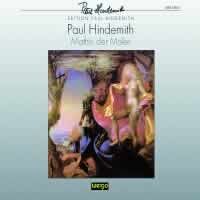
Mathis der Maler is one of the pinnacles of 20thcentury German opera. It's become axiomatic to see in it a parable of the times, with Hindemith using the turbulent world of 16th-century Germany...
Special offer. Hindemith: Mathis der Maler
John Cogram, Werner Hagen, Victor von Halem, Sabine Hass, Roland Hermann, Ulrich Hielscher, Heinz Kruse, Josef Protschka, Ulrich Ress, Godfried Ritter, Gabriele Rossmanith, Marilyn Schmiege, Harald Stamm, Hermann Winkler
Chor des Norddeutschen Rundfunks, Kölner Rundfunkchor, Kölner Rundfunk-Sinfonie-Orchester,...
Purchase product
Mathis der Maler is one of the pinnacles of 20thcentury German opera. It's become axiomatic to see in it a parable of the times, with Hindemith using the turbulent world of 16th-century Germany...
About
"... Ancient folksongs, battlesongs from the time of the Reformation, and Gregorian chant, these provide the fertile soil from which the music in 'Mathis' grows, which hopefully spreads at least a faint reflection of the light under whose warming rays it was able to bloom: the spirit of one of the greatest artists we have ever seen." (Paul Hindemith, 1938)
Hindemith's opera "Mathis der Maler" was written between the years 1933 and 1935. The relevance of the material, especially the problem of combining artistic activity and politics, was immediately recognized. For Hindemith - as he mentioned himself several times - the period of artistic noncommitment was over; the works to be created would have to be of a different kind, a music emphasizing more than mere virtuosity or entertainment; he became aware at this time that the artist holds a position of high responsibility toward humanity as well as for art and the defence of art. Hindemith shares this attitude towards art with Mathis, who - at the beginning of the 16th century - experienced the dawn of a new age with its inevitable destruction of the perceptions which until then had held sway, and who also chose to concentrate in his work on the unfolding of tradition. The opera "Mathis der Maler" is the first document of this new position; it is a work that seeks to cause everything personal and temporal, if not to be forgotten, at least to recede into the background.
Artists
John Cogram, Werner Hagen, Victor von Halem, Sabine Hass, Roland Hermann, Ulrich Hielscher, Heinz Kruse, Josef Protschka, Ulrich Ress, Godfried Ritter, Gabriele Rossmanith, Marilyn Schmiege, Harald Stamm, Hermann Winkler
Chor des Norddeutschen Rundfunks, Kölner Rundfunkchor, Kölner Rundfunk-Sinfonie-Orchester, Gerd Albrecht
Contents and tracklist
- John Cogram, Werner Hagen, Victor von Halem, Sabine Hass, Roland Hermann, Ulrich Hielscher, Heinz Kruse, Josef Protschka, Ulrich Ress, Godfried Ritter, Gabriele Rossmanith, Marilyn Schmiege, Harald Stamm, Hermann Winkler
- Chor des Norddeutschen Rundfunks, Kölner Rundfunkchor, Kölner Rundfunk-Sinfonie-Orchester
- Gerd Albrecht
Awards and reviews
 2010
2010
Mathis der Maler is one of the pinnacles of 20thcentury German opera. It's become axiomatic to see in it a parable of the times, with Hindemith using the turbulent world of 16th-century Germany to mirror the Nazi Reich and his place in it.
But in reality Mathis is a spiritual and historical opera, not a political one. Rudolf Stephan in his note plays down the political angle; if Hitler hadn't risen to power until, say, 1936, one doubts that Mathis would have turned out much different.
Gerd Albrecht's acquaintance with Hindemith's music goes back to the early 1960s, before the composer's death. Hindemith even sanctioned some retouching of the orchestration in Mathis made by Albrecht for a festival performance, though it isn't made clear whether Albrecht has applied this here. Rarely have Hindemith's often heavy textures sounded so clear.
As to the music, isn't the brief concluding 'Alleluia' duet that crowns the sixth tableau one of the great moments in 20th-century opera? You'll be convinced from your first hearing of it.
There are fine moments aplenty in Albrecht's reading, not least where familiar passages from the Mathis Symphony surface and precipitate some of the most intense music of the opera.
Roland Hermann is, perhaps, a shade stolid in places as the painter (though his world-weariness in the final scene is just right); Josef Protschka makes a most authoritative Cardinal, acting as a perfect foil to Hermann's Mathis. They head a fine cast, supported by some lusty singing and playing from German radio forces.