Previously unpublished David Oistrakh
David Oistrakh (violin) & Vladimir Yampolsky (piano)
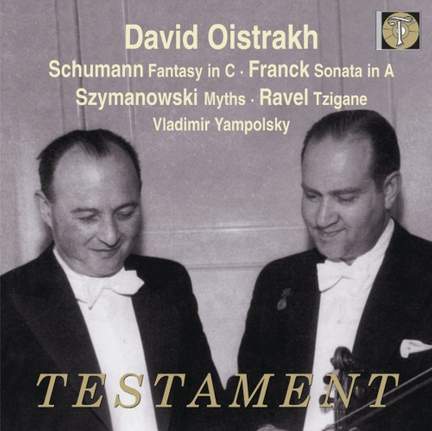
Best of this previously unpublished late-1950s Bucharest recital is Oistrakh's breathtaking account of Szymanowski's Myths. Despite poor piano sounds, the Franck Sonata and Ravel Tzigane are...
Previously unpublished David Oistrakh
David Oistrakh (violin) & Vladimir Yampolsky (piano)
Purchase product
Best of this previously unpublished late-1950s Bucharest recital is Oistrakh's breathtaking account of Szymanowski's Myths. Despite poor piano sounds, the Franck Sonata and Ravel Tzigane are...
About
This Enescu Festival programme is a very interesting one, beginning with a ‘stepchild’ of the repertoire. Schumann’s music for violin and orchestra, intended for Joseph Joachim, has had even less exposure than his other violin music: the Concerto was buried in a library until the 1930s, when Joachim’s great-niece Jelly d’Arányi successfully lobbied for its release, and the fine C major Fantasy had few champions – Adolf Busch was one, playing it regularly, and Fritz Kreisler went to the trouble of making his own piano transcription. That is the version played here by Oistrakh and Yampolsky and it is new to the violinist’s discography. The Franck Sonata, on the other hand, featured frequently in Oistrakh recitals and he recorded it with both Oborin and Yampolsky, also leaving us three live versions with Richter. This performance captures him ‘on the wing’ when he was still in his prime. Karol Szymanowski knew the violin well – one of his dearest friends was the Russian-born Polish virtuoso Pawel Kochan´ski – and wrote two concertos, a sonata, a set of three Myths, a Nocturne and Tarantella and some short pieces for it. Oistrakh and Yampolsky made famous studio recordings of the sonata and The Fountain of Arethusa, but this is their only known document of the other two Myths. The pieces, written in 1915–16 with the encouragement of Kochan´ski – who assisted with the exotic violinistic effects – are among the treasures of the late Romantic repertoire but need first-rate players like these to reveal all their beauties. The same can be said of Ravel’s exciting Tzigane, composed for d’Arányi. We do have other Oistrakh recordings of it, including one with Yampolsky, but it is a piece which thrives on the frisson of a live occasion and here it meets a great virtuoso who can do it justice. Extract from the note © Tully Potter, 2008
Contents and tracklist
- arr. Kreisler
- David Oistrakh (violin) & Vladimir Yampolsky (piano)
- David Oistrakh (violin) & Vladimir Yampolsky (piano)
- David Oistrakh (violin) & Vladimir Yampolsky (piano)
Awards and reviews
 February 2009
Best of this previously unpublished late-1950s Bucharest recital is Oistrakh's breathtaking account of Szymanowski's Myths. Despite poor piano sounds, the Franck Sonata and Ravel Tzigane are as compelling.
 2010
2010
Here we have a fabulous unpublished programme that not only offers us new David Oistrakh repertoire but, in the case of the works we do already have from him, delivers performances that are sufficiently distinctive to warrant the duplication.
Take César Franck's Sonata, where Oistrakh's vibrato is more expressively intense than it often is on disc and where Vladimir Yampolsky transcends his familiar 'accompanist' role to assert an individual musical personality with playing that in its freedom and grandeur at times reminded me of Cortot, no less. Ravel's Tzigane is another winner – witty, spontaneous, incisive in its attack and, near the end, dangerously fast.
Other available Oistrakh Tziganes also deliver, musically speaking, but none sounds quite so thrillingly off the cuff.
And then there are the newcomers to Oistrakh's discography, all of them fine works. The Szymanowski Myths 'Narcissus' and 'Dryads and Pan' extend the experience we already have of Oistrakh in the opening 'Fountain of Arethusa' with seductive tone production, filigree passagework and a sense of play that perfectly matches Szymanowski's fantastical imagination. The late and rather discursive Schumann Fantasy in C, presented here with Fritz Kreisler's rich piano reduction, is a true tour de force, bittersweet one moment, boldly virtuoso the next and graced by a uniquely rounded musical sensibility that left the world the day David Oistrakh died.
Happily we still have the records, with this 1958 Bucharest recital being one of the finest of all. The sound is fairly good, the balance variable but never skewed. Utterly unmissable.
 February 2009
Don't miss this fabulous rarity - a genuinely unpublished recital from '58. The Szymanowski Myths "Narcissus" and "Dryads and Pan" extend the experience we already have of Oistrakh in the opening "Fountain of Arethusa" with seductive tone production, filigree passagework and a sense of play that perfectly matches Szymanowski's fantastical imagination. Utterly unmissable...