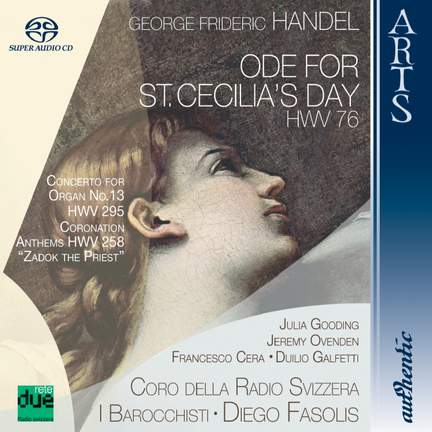
Handel - Ode for St. Cecilia’s Day
Jeremy Ovenden (tenor), Julia Gooding (soprano) & Francesco Cera (organ)
Coro della Radio Svizzera & I Barocchisti, Diego Fasolis
The finest aspects of the ode's performance are the refined moulding of the choral phrases and the excellent playing from I Barocchisti. Fasolis achieves plenty of sympathetic tastefulness...
Handel - Ode for St. Cecilia’s Day
Jeremy Ovenden (tenor), Julia Gooding (soprano) & Francesco Cera (organ)
Coro della Radio Svizzera & I Barocchisti, Diego Fasolis
Purchase product
The finest aspects of the ode's performance are the refined moulding of the choral phrases and the excellent playing from I Barocchisti. Fasolis achieves plenty of sympathetic tastefulness...
About
The “Ode on St. Cecilia's Day” was originally written in the year 1697 to a text by John Dryden (1631-1700), one of the major poets of the classical era. Cecilia was a Christian woman martyr who has become the patron saint of musicians due to her legendary musical skills. The encounter with Drydens’ Ode for Cecilia was Handel’s first contact with English poetry, and he set the words into music at a time when his success as a composer of Italian influenced operas had begun to falter.
The other works featured on the disc, the Concerto for Organ No. 13 HWV 295 and the festive anthem “Zadok the Priest”, were the sort of pieces often performed by Handel himself alongside larger scale works like the Ode on St. Cecilia during his concert series. One of four Coronation Anthems that Handel composed for the coronation of George II in 1727, Zadok the Priest (HWV 258) was written by the composer to texts from the King James Bible. It has been sung at every subsequent British coronation service.
Diego Fasolis studied at the Conservatory of Zurich and later with Gaston Litaize and Michael Radulescu. Since 1988 he has been conductor of the early music ensemble "I Barocchisti", with whom he has made a string of successful discs on the “Arts” label, including acclaimed recordings of J.S. Bach’s Orchestral Suites and Brandenburg Concertos. Featured soloists on this hybrid SACD of these two cantatas, include the renowned soprano Nancy Argenta, and the bass Klaus Mertens who has been a regular collaborator with Ton Koopman on his outstanding series of Bach recordings for the dutch label “Challenge Classics”.
Contents and tracklist
- I Barocchisti, Diego Fasolis, Jeremy Ovenden, Coro della Radio Svizzera, Julia Gooding
- I Barocchisti, Diego Fasolis, Francesco Cera
- I Barocchisti, Diego Fasolis, Coro della Radio Svizzera
Awards and reviews
 February 2009
The finest aspects of the ode's performance are the refined moulding of the choral phrases and the excellent playing from I Barocchisti. Fasolis achieves plenty of sympathetic tastefulness in orchestral textures… performance of the Organ Concerto No 13 is enchanting, with soloist Francesco Cera displaying fluent technique and choosing appealing registrations.