Special offer. Liszt - Symphonic Poems Volume 4
BBC Philharmonic, Gianandrea Noseda
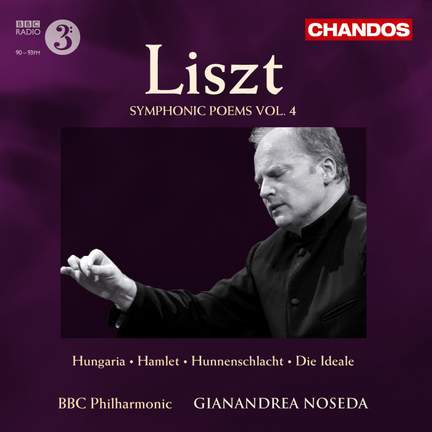
utterly gripping in Noseda’s hands and puts fine versions by Bernard Haitink and Kurt Masur quite in the shade
Special offer. Liszt - Symphonic Poems Volume 4
BBC Philharmonic, Gianandrea Noseda
Purchase product
utterly gripping in Noseda’s hands and puts fine versions by Bernard Haitink and Kurt Masur quite in the shade
About
This is the fourth volume of the BBC Phiharmonic’s five-disc cycle of Liszt’s Symphonic Poems, conducted by Gianandrea Noseda. This monumental survey continues to go from strength to strength through Noseda’s passionate conducting and innate Italian romanticism and has made possible a reappraisal of these unjustly neglected works. The Telegraph wrote, “…it is hard to imagine them ever sounding better than here. This is music-making full of rich colouring, refined shaping of melodic line and emotional power.”
Between 1848 and 1858 Liszt wrote twelve Symphonic Poems. He coined the term Symphonische Dichtung around 1853 to describe these musical works whose ideas were inspired by other art forms such as poetry or painting, or by characters and scenes. The works were particularly revolutionary for they are one-movement compositions, rather than the traditional four-movement form and pushed the boundaries of orchestration, form, harmony and structure.
In this fourth instalment, the BBC Philharmonic presents four key works in Liszt’s symphonic catalogue. Widely acknowledged as one of Liszt’s greatest works, Hamlet is rarely performed, yet widely acknowledged as one of Liszt’s greatest works, and chronologically the last of the symphonic poems to be composed. It was intended as an overture to Shakespeare’s play. Hungaria was composed following Liszt’s first return visit to Hungary in 1839 having moved from his homeland aged 11. He was welcomed with open arms as a great celebrity and artist by his compatriots Undoubtedly inspired by this visit, the post Vörösmarty wrote his patriotic ode ‘To Ferenc Liszt’ to which Liszt eventually responded with his episodic work, Hungaria. Die Ideale is a highly episodic work based on quotes from a poem by Friedrich Schiller and was first played in 1857 in Weimar, conducted by the composer. The final work, Battle of the Huns takes its inspiration from Kaulbach’s painting of Attila the Hun.
The final volume of this epic series is released in 2009 and will include the Dante Symphony.
Contents and tracklist
- Gianandrea Noseda, BBC Philharmonic
- Recorded: 1-2 February 2008
- Recording Venue: Studio 7, New Broadcasting House, Manchester
- Gianandrea Noseda, BBC Philharmonic
- Recorded: 1-2 February 2008
- Recording Venue: Studio 7, New Broadcasting House, Manchester
- Gianandrea Noseda, BBC Philharmonic
- Recorded: 1-2 February 2008
- Recording Venue: Studio 7, New Broadcasting House, Manchester
- Gianandrea Noseda, BBC Philharmonic
- Recorded: 1-2 February 2008
- Recording Venue: Studio 7, New Broadcasting House, Manchester
Awards and reviews

utterly gripping in Noseda’s hands and puts fine versions by Bernard Haitink and Kurt Masur quite in the shade
 2010
2010
Volume 4 of Chandos's superb cycle of Liszt's symphonic poems takes us through Hungaria, Hamlet and Hunnenschlacht ('The Battle of the Huns') to Die Ideale. Liszt's orchestral resources and easy sense of the picturesque still provoke endless debate among avid Lisztians and equally avid detractors. And it is true that his ever-ready susceptibility can involve stock-in-trade gestures and responses, and a wholly 19th-century rhetoric. Yet when performed with such superfine brilliance as here, everything is made irresistibly vital and graphic.
Here you sense how Liszt's first audiences were fired to a renewed sense of nationalism as they listened to Hungaria, a glorified Hungarian rhapsody where muted fanfares and foreboding lead to ultimate triumph and freedom from repression. Hamlet to an even greater extent achieves its stature through extreme contrasts of violence and introspection, while Hunnenschlacht is alive with a whirling chromaticism and insistent rhythm making terms such as marziale, eroico and trionfante as central to its theme as in Hungaria. Again, Die Ideale may commence with a gloomy quote from Schiller but all possible pessimism is resolved by Liszt's preoccupation with duality; with triumph and defeat, good and evil, etc. All these qualities are conveyed by orchestra and conductor in a way that tells you that true virtuosity is achieved through discipline rather than a more generalised and garish drama. This finely recorded disc is a glorious addition to the series.
 January 2009
…when performed with such superfine brilliance as here, everything is made irresistibly vital and graphic.