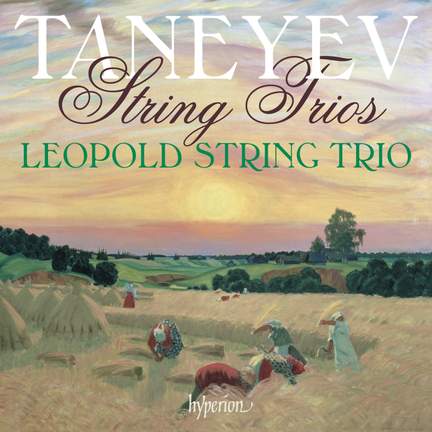
Taneyev - String Trios
Leopold String Trio
Listening to the three trios that the Leopold String Trio present with such commitment and persuasiveness leaves no doubt as to Taneyev's contrapuntal ingenuity and resource. …E flat Trio of...
Taneyev - String Trios
Leopold String Trio
Purchase product
Listening to the three trios that the Leopold String Trio present with such commitment and persuasiveness leaves no doubt as to Taneyev's contrapuntal ingenuity and resource. …E flat Trio of...
About
‘He is the greatest master of counterpoint in Russia; I am not even sure there is his equal in the West’, was Tchaikovsky’s verdict on his protégé, champion and friend Sergei Ivanovich Taneyev. Director of music at the Moscow Conservatory from 1885, Taneyev was a uniquely important figure in Russian musical history, a master of counterpoint who disliked the Nationalist school and instead cultivated a distinctive style that transcended national genres.
Taneyev’s works for string trio demonstrate among other things his great contrapuntal abilities. His excursions into this genre were perhaps the first by a Russian composer; certainly the first of such high quality.
The Leopold String Trio is firmly established at the forefront of the international chamber music scene and received the 2005 Royal Philharmonic Society Chamber Ensemble Award: ‘Through the sheer brilliance and maturity of their playing, their collaborations with other outstanding performers, and their enterprise and imagination in programming, commissioning and touring, the Leopold String Trio have shown uncompromising dedication to an other-wise neglected genre, and advocacy for the richness of chamber music as a whole.’
Contents and tracklist
Awards and reviews
 November 2008
Listening to the three trios that the Leopold String Trio present with such commitment and persuasiveness leaves no doubt as to Taneyev's contrapuntal ingenuity and resource. …E flat Trio of 1911… is masterly and deserves to rank alongside the remarkable Piano Quintet Op. 30 of the same year.
 2010
2010
Given the scarcity of Russian contributions to this traditionally most demanding of chamber media, there is all the more reason to investigate what Russia's greatest master of counterpoint (according to Tchaikovsky and others well placed to comment) does with it.
Hyperion has wisely placed the finest of the three first. The E flat Trio (1910-11) is chronologically second, and apart from Taneyev's usual craftsmanly values, there is a winning freedom of invention. The first movement has the confidence to go down inviting sidetracks, confident that there will be marvels to bring back. One of Taneyev's trademark quick-witted scherzos follows – irresistibly charming – then a gorgeously warm-hearted slow movement, with plentiful florid yet never tasteless elaboration, and a jocund finale. Given that the lowest part of the E flat Trio was conceived and published for the tenor viola (tuned a fourth higher than the cello) there is some justification for Kate Gould's occasional redistribution of the texture; though if anyone can dig out an example of the original instrument it would be fun to compare.
After this the unfinished B minor Trio (1913), partially reconstructed from sketches for its posthumous first publication, is a tougher nut, grainier in its texture and more heavily shadowed in its moods – a sober and impressive footnote to one of the great chamber music composing careers.
The D major Trio (1879-80) is a perfectly respectable debut in the medium, checking every step of the way before boldly going where no major Russian composer had gone before.
It would be hard to over-praise the Leopold Trio's performances. Agility and all-round aplomb? Check. Warmth and colour? Check.
Structural and idiomatic awareness? Check. Fine recording quality and helpful annotation (Calum MacDonald) too; so no reason not to invest.
 November 2008
It would be hard to over-praise the Leopold Trio's performances. Agility and all-round aplomb? Check. Warmth and colour? Check. Structural and idiomatic awareness? Check. Fine recording quality and helpful annotation… too; so no reason not to invest.