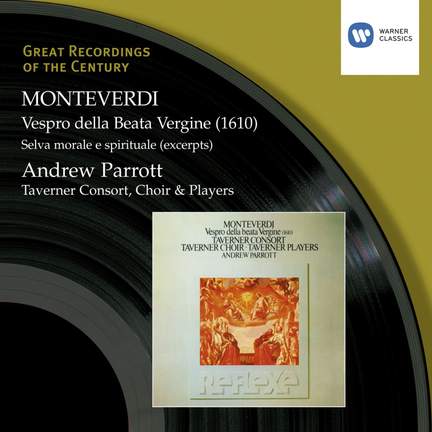
Monteverdi - Vespers
Taverner Consort Choir & Players, Andrew Parrott
Awards:
-
Gramophone Magazine, July 2026, Collection Winner

One of the earliest and best Vesper sets, certainly the prettiest-sounding. The quality of singers, the rising early music stars of their age, is unsurpassed.
Monteverdi - Vespers
Taverner Consort Choir & Players, Andrew Parrott
Purchase product
Awards:
-
Gramophone Magazine, July 2026, Collection Winner
One of the earliest and best Vesper sets, certainly the prettiest-sounding. The quality of singers, the rising early music stars of their age, is unsurpassed.
About
This path-breaking early digital recording of the 1610 Vespers remains a benchmark and a favourite whenever versions of this work come up for consideration.
Andrew Parrott’s starting-point was that the music was written for a Marian Vespers, and is therefore best heard in its liturgical context. So we have the appropriate plainchant antiphon before each psalm, and other chant required by liturgy.
Just as vital was the question of pitch. Parrott was the first conductor to confront, and eventually solve, the problem posed by the apparent higher pitch of the Magnificat and the Lauda Ierusalem. Read correctly, and following a convention that was well understood at the time, the music is here performed a 4th below written pitch. The arguments are arcane but unanswerable. Before Parrott’s example, fully a quarter of the Vespers was always performed in a sort ‘stratospheric scramble’.
Last but not least, this is music in the concertato style, for highly skilled soloists. Here, rather than the anachronistic modern convention that has certain sections ‘full choir’ and only the more intricate passages given to soloists, each part is in general sung by a single voice, as Monteverdi intended. The lines become clearer, the solo voices combine and answer one another with a marvellous flexibility and expressiveness.
The couplings are taken from a 1982 disc of Venetian vesper music, some of which has not reappeared since that first issue.
Awards: FFFF de Télérama, Caecilia Prijs (Belgium)
Contents and tracklist
- Andrew Parrott (director), Emma Kirkby (soprano), David Thomas (bass), Roger Covey-Crump (vocals), Rogers Covey-Crump (tenor), Taverner Consort (vocal ensemble), Nigel Rogers (tenor)
- Taverner Choir, Taverner Players, Wiener Johann Strauss Orchester
- Andrew Parrott, Willi Boskovsky
- Emma Kirkby (soprano), David Thomas (bass), Nigel Rogers (vocals), Roger Covey-Crump (vocals), Rogers Covey-Crump (tenor), Taverner Players (lead vocals)
- Taverner Choir, Taverner Consort
- Andrew Parrott
- Andrew Parrott (director), Emma Kirkby (soprano), David Thomas (bass), Nigel Rogers (vocals), Roger Covey-Crump (vocals), Rogers Covey-Crump (tenor), Taverner Players (lead vocals)
- Taverner Choir, Taverner Consort
- Andrew Parrott
- Taverner Choir, Emma Kirkby (soprano), David Thomas (bass), Nigel Rogers (tenor), Rogers Covey-Crump (tenor), Taverner Players, Andrew Parrott (director), David Thomas [1]-[3], [5]-[7], [9] (bass), Roger Covey-Crump (vocals)
- Taverner Consort
- Andrew Parrott
- Emma Kirkby (soprano), David Thomas (bass), Roger Covey-Crump (vocals), Rogers Covey-Crump (tenor)
- Taverner Choir, Taverner Consort
- Andrew Parrott
- Andrew Parrott (director), David Thomas [1]-[3], [5]-[7], [9] (bass), Emma Kirkby (soprano), Nigel Rogers (tenor), Roger Covey-Crump (vocals), Rogers Covey-Crump (tenor), Taverner Players (lead vocals)
- Taverner Choir, Taverner Consort
- Andrew Parrott
Awards and reviews
-
Gramophone MagazineJuly 2026Collection Winner
 March 2009
One of the earliest and best Vesper sets, certainly the prettiest-sounding. The quality of singers, the rising early music stars of their age, is unsurpassed.
 2010
2010
The technical and interpretative problems of the Monteverdi Vespers of 1610 are legion.
Should the entire volume be performed as an entity, or just the psalms, or perhaps a mixture of psalms and motets? Since the vocal lines in the original are heavily ornamented, does this preclude the addition of further embellishment after the manner of contemporary instruction books? Which portions should be sung chorally (and how large should such a 'choir' be?), and which by the soloists? How should the continuo be realised? The central controversy concerns five nonliturgical compositions inserted among the Marian psalms, hymn and 'Magnificat'. These, the sacred concerti described on the title-page as 'suitable for the chapels or private chambers of princes', don't conform textually to any known Marian office but occur in Monteverdi's collection in positions normally occupied by psalm antiphons. Here the concerti are performed as substitutes for the antiphons missing from Monteverdi's collections. One effect is to make this version feel more unified and monumental.
Both physically and emotionally the concerti are presented here as the focal points of the Vespers.
Certainly they're the occasion for some of the most spectacular singing. The essential ingredient is the performance of Nigel Rogers, surely the most accomplished and convincing singer of the early 17th-century Italian virtuoso repertory. He gives persuasive and seemingly effortless performances in three of the concerti in his mellifluous, dramatic yet perfectly controlled manner. In two cases, 'Audi coelum' and 'Duo Seraphim', he's well matched with Andrew King and Joseph Cornwell. 'Pulchra es', sung by Tessa Bonner and Emma Kirkby, seems comparatively rather understated.
One important feature of Andrew Parrott's interpretation is its fundamental conception, historically accurate, of the Vespers as chamber work rather than a 'choral' one. Thus only one instrument is used per part, the harpsichord is employed very sparingly, and the basic continuo group is restricted to organ and chitarrone.
Following the same principle, one voice per part is taken as the norm. The result is a clarity of texture, evident from the opening bars, which allows correct tempos to be used without stifling often intricate rhythmic features.
Another fundamental choice represents something of a novelty. Both 'Lauda Jerusalem' and the 'Magnificat' are transposed down a fourth here, as they should be according to the convention relating to the clef combinations in which they were originally notated. This brings all the vocal parts into the tessitura of the rest of the work, and restores the instruments to their normal ranges. Whether or not the result is less 'exciting' than the version we're used to hearing has only partly to do with questions of musicality. For the rest, one of the lasting virtues of this well-balanced, unobtrusive recording is that it allows us to hear the Vespers sounding something along the lines that Monteverdi intended.
 June 2010
...with some of Britain's finest consort singers & instrumentalists involved, and model solo contributions from Emma Kirkby and Nigel Rogers, there is a vocal clarity and beauty here that gives the work a new humanity and intimacy.