Koechlin: Le Docteur Fabricius
Stuttgart Radio Symphony Orchestra, Heinz Holliger
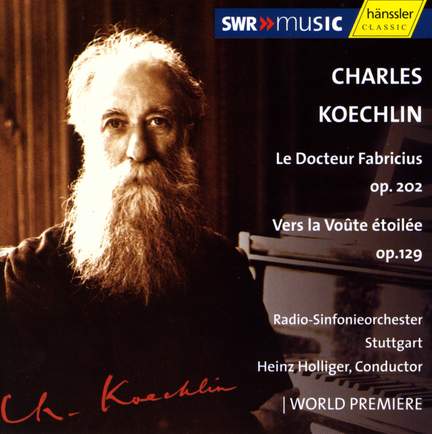
Much of Koechlin's highly individual orchestral music remains unexplored: indeed, both works here are premiere recordings. Before he became a composer, Koechlin wanted to be an astronomer and...
Koechlin: Le Docteur Fabricius
Stuttgart Radio Symphony Orchestra, Heinz Holliger
Purchase product
Much of Koechlin's highly individual orchestral music remains unexplored: indeed, both works here are premiere recordings. Before he became a composer, Koechlin wanted to be an astronomer and...
About
Contents and tracklist
- Christine Simonin
- Radio-Sinfonieorchester Stuttgart des SWR
- Heinz Holliger
Awards and reviews
 2010
2010
Much of Koechlin's highly individual orchestral music remains unexplored: indeed, both works here are premiere recordings. Before he became a composer, Koechlin wanted to be an astronomer and his fascination with the 'starry firmament', and the dream-world it evoked, is sensuously created in the arch-like structure of Vers la voûteétoilée ('Towards the vault of stars'). Written in the early 1920s and revised in 1939, this demonstrates the composer's exotic sound-world in a nocturnal piece that doesn't outstay its welcome.
The stars in the heavens return in Le DocteurFabricius, written 1941-4, a more ambitious, large-scale symphonic poem with a philosophical underlay, based on a short story by the composer's uncle. The narrative describes a visit to the mysterious house in which the nihilistic Doctor Fabricius has cut himself off from the world.
After an austere opening, dolorous chorales symbolise the philosophical disillusion, interrupted by a strident, fugal revolt and interwoven with moments of sadness. A powerfully scored chorale suggests that human hope always re-emerges.
The visitor looks out to the starry firmament (the ondes martenot-rich scoring suggests Messiaen) and then, in a passage of radiant exultation, the spirit of Ravel hovers over the music to evoke the consolation of Nature. After an explosion of joy the music returns to the serene, withdrawn evocation of the opening.
Koechlin's powers as an orchestrator ensure his vision is powerfully communicated. Heinz Holliger is very much at home here, and the Stuttgart Radio orchestra play most responsively.
The recording is full and atmospheric, though one ideally needs a more voluptuous ambience. But this is well worth trying.