Special offer. Schubert: Piano Works
Sebastian Knauer (piano)
Ensemble Resonanz
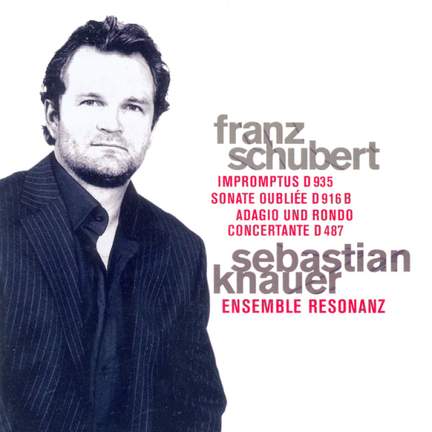
This disc is invaluable on two fronts. First, it introduces us in a first recording to 572 bars of original Schubert with a complementary six bars, all thanks to the sensitive scholarship of...
Special offer. Schubert: Piano Works
Sebastian Knauer (piano)
Ensemble Resonanz
Purchase product
This disc is invaluable on two fronts. First, it introduces us in a first recording to 572 bars of original Schubert with a complementary six bars, all thanks to the sensitive scholarship of...
About
Contents and tracklist
Work length14:09
Awards and reviews
 2010
2010
This disc is invaluable on two fronts. First, it introduces us in a first recording to 572 bars of original Schubert with a complementary six bars, all thanks to the sensitive scholarship of Jörg Demus and Roland Solder. Second, it presents a 36-year-old German pianist whose playing is a marvel of robust eloquence and unfaltering mastery, free from all distracting caprice or idiosyncrasy. Entitled by the editors 'The Forgotten Sonata', D916b is a classic instance of Schubert at his most audacious and experimental.
Indeed, it is hard to imagine the opening Allegro's taut, quasi-orchestral splendour and poetic inwardness, the central Allegretto's enigma or the finale's Marcia as gracing a fireside Schubertiade. The Adagio and Rondo concertante, too, which is as close as Schubert got to writing a piano concerto (there are solo and tutti markings in the score), is richly inventive particularly when presented by both pianist and ensemble with such authority.
Then, on more familiar territory, Knauer, who has studied with András Schiff and Christoph Eschenbach, gives us the second book of Impromptus, at once inviting comparison with even the finest Schubertians. Not for him the nervous telescoping of the A flat Impromptu's rhythm but a truly remarkable poise and insight.
The final Impromptu may be taken at a spanking pace but once again the clarity and focus are enviable. All these performances are as disciplined as they are acute.