Special offer. Palladians - The Devil’s Trill
Palladians
Finely judged engineering, with the added aural dimension of surround-sound, create an enveloping warmth which intensifies the powerful rhetoric and expressiveness of the performance; this is...
Special offer. Palladians - The Devil’s Trill
Palladians
Purchase product
Finely judged engineering, with the added aural dimension of surround-sound, create an enveloping warmth which intensifies the powerful rhetoric and expressiveness of the performance; this is...
About
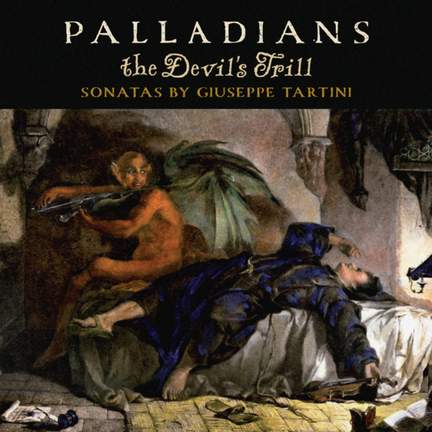
A brand new recording by Palladians features programmatic sonatas by Tartini, including the famous Devil’s Trill Sonata (inspired by a dream in which he made a pact with the Devil). Also included is a sonata by Veracini, whose skilful playing was a great influence on the young Tartini.
• Famed throughout Europe as a pre-eminent virtuoso, Tartini was a private, secretive man, only revealing his true character through secret codes in his manuscripts.
• Tartini’s programmatic sonatas ('Didone Abandonata' and ‘The Devil's Trill’ - a deservedly celebrated masterpiece) display his intense pictorial inward gaze that sets him apart from his many Italian colleagues.
• Veracini’s legendary virtuosity (which led Tartini to temporarily withdraw into solitudinous practice) created a storm of success in England and led to the popular toast 'One God, One King, and One Veracini!'
• Palladians is firmly established on the international stage as one of the very best chamber groups performing baroque repertoire. Constant critical acclaim, a reputation for dashing, intelligent musicianship and a warm, spontaneous on-stage manner has led this virtuoso ensemble to give numerous concert and radio performances in the UK
• Palladians are five times winners of the prestigious Diapason d'Or Award, (1993, 1994, 1998, 1999 and 2000) and has twice had albums named Gramophone "Editor's Choice".
Contents and tracklist
- Palladians, Rodolfo Richter
- Recorded: 6-8 November 2006
- Recording Venue: St. Andrew's Church, Toddington, United Kingdom
- Palladians, Rodolfo Richter
- Recorded: 6-8 November 2006
- Recording Venue: St. Andrew's Church, Toddington, United Kingdom
- Palladians, Rodolfo Richter
- Recorded: 6-8 November 2006
- Recording Venue: St. Andrew's Church, Toddington, United Kingdom
- Palladians, Rodolfo Richter
- Recorded: 6-8 November 2006
- Recording Venue: St. Andrew's Church, Toddington, United Kingdom
- Palladians, Rodolfo Richter
- Recorded: 6-8 November 2006
- Recording Venue: St. Andrew's Church, Toddington, United Kingdom
- Palladians, Rodolfo Richter
- Recorded: 6-8 November 2006
- Recording Venue: St. Andrew's Church, Toddington, United Kingdom
Awards and reviews
 October 2008
Finely judged engineering, with the added aural dimension of surround-sound, create an enveloping warmth which intensifies the powerful rhetoric and expressiveness of the performance; this is breath-taking stuff.
A group whose quick-witted inventiveness and almost supernatural internal rapport never fail to delight.
 February 2009
Rodolfo Richter is a perfect violinist for this music, a player whose rock-solid technique, shining liquid tone and easy bowing allow him a rhythmic and lyrical freedom that really does seem to make his instrument sing. As one might expect from the Palladians, the continuo-playing is of a high order, imaginative but never clamouring for attention.
 17th August 2008
[The Violin Sonata in G Minor 'Devil's Trill'] is a masterly work, and its Opus 1 companion in the same key, Didone abbandonata (Dido Abandoned), are the great baroque violinist/composer’s masterpieces, frequently recorded, but rarely with the gusto and technical address displayed by Rodolfo Richter, the Palladians’ “soloist”, but a primus inter pares of this outstanding baroque group.
 23rd August 2008
This is in many ways a beautiful disc, with exquisite playing from all four members of the authentic instrument group. But the fiendish series of rising double-stopped trills in each of the three quick sections of the last movement of Tartini’s infamous sonata lack definition. The loose recitativo rhythm doesn’t help. Neither, one suspects, does the baroque pitch. A brighter, thinner tone should surely have helped.